

woom OFF and OFF AIR 4, 5 and 6 Review

The woom OFF and OFF AIR kids mountain bikes are the perfect bikes to get your little rider to fall in love with the trail. Lightweight and responsive, the OFF is simply a magnificent beast that “floats like a butterfly (and) sting(s) like a bee”. We’ve seen time and time again the woom OFF turn timid and hesitant riders into groms and give experienced riders the confidence to ride farther and faster.
Having reviewed every version of the woom OFF and OFF AIR with countless riders since its release in 2019, we’ve seen firsthand the fabulous and fun features of the woom OFF, as well as a few things we’d like to see improved.
In this review, we’ll cover everything you need to know about the woom OFF (rigid) and OFF AIR series (same bike but with an air suspension fork), including who we believe the woom OFF bikes are best for and how they compare to their competitors.

woom OFF and OFF AIR
MSRP: OFF: $849+, OFF AIR: $1,199+
BEST FOR: Beginning and Intermediate trail riders riding less than ~500ft elevation gain
WHEEL SIZES: 20”, 24” and 26”
SUSPENSION: OFF: None, OFF AIR: Air fork with 60-90mm travel w/ adjustable compression, rebound damping and lock out
WEIGHT: OFF: 18.9+ lb., OFF AIR: 21.7+ lb.
ADDITIONAL SPECIFICATIONS
BRAKES: Promax Hydraulic Disc
SHIFTERS: SRAM X5 trigger shifter
DERAILLEUR: SRAM X5 rear derailleur, 9-speed
TIRES: 2.35″ wide Schwalbe Rocket Ron with ADDIX SPEED rubber compound
What we love about the woom OFF and OFF AIR
- Lightweight, nimble, and perfectly balanced to help kids build and develop skills on the trail
- SRAM X5 trigger shifters are easy for young kids to engage
- Comfortable, confidence-building geometry; stack height is just right for beginning riders—not too aggressive
- Rims and tires are tubeless compatible (ready for conversion, though rims are not taped) and 24” and 26” are dropper post compatible
- All three sizes offer more room for growth compared to competitors
- Hydraulic disc brakes with dual 140mm rotors on the 20″, and dual 160mm rotors on the 24″ and 26″
- Integrated rubber chainstay protector helps protect the frame from chainslap
- Lightweight, fully functional RST-built air fork with adjustable rebound and lockout on OFF AIR
What you should know before you buy
- The woom OFF and OFF AIR are exactly the same—the OFF AIR just has a suspension fork
- These bikes are cross-country/trail bikes, not aggressive downhill bikes; they are designed with climbing as much a priority as descending
- All three sizes lack a really low climbing gear; for kids regularly climbing over 500 ft. or tackling super steep pitches, the gearing of the OFF is less than ideal
- The fork (1” to 1 ⅛” tapered), cranks, and grips are not compatible with other brands and can only be replaced with woom parts
- Available in three sizes—20″, 24″, and 26″—all of which are slightly larger than the woom GO and EXPLORE series
woom OFF and OFF AIR Review – Frequently Asked Questions
Woom’s secret sauce is where many larger bike brands fail. Instead of prioritizing lightweight design and comfort, both essential for young riders, larger brands often focus on looks at the expense of weight and performance.
While there are a lot of “shrunken-down adult bikes” for kids out there, there aren’t many true, trail-worthy kids’ mountain bikes like the woom OFF and OFF AIR. All too often, brands just throw on some knobby tires and mechanical disc brakes on a decent looking frame and call it good. Sure, the gearing may be bad and the bike might weigh a ton—but as long as it looks like a mountain bike, it counts, right?
If you want a true mountain bike for young riders, you’re in the right place. For the past six years, we’ve put the woom OFF and OFF AIR to the test with countless testers across multiple states and can testify to their awesomeness.
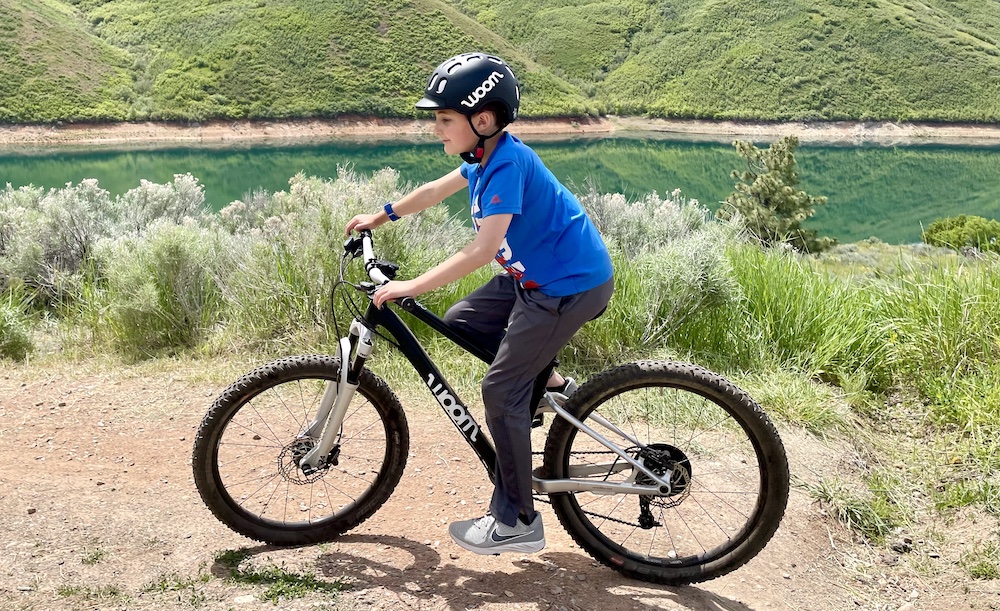
There’s a lot to love about the woom OFF series, but also a few things we’d still like to see improved. From fit to function, we’ll cover everything you need to know about the woom OFF—starting with frequently asked questions.
Why a woom?
Based in Austria, woom bikes is dedicated to making the best bikes for kids. They only make kids’ bikes, so they clearly need to get it right—and they have. From grips to geometry, no detail is too small in their mission to make the best. Since releasing their OFF series in 2019, woom has continued to improve the OFF with meaningful updates.
Who is the woom OFF best for (rigid – no suspension)?
Beginning mountain bikers focused on riding basic to intermediate singletrack. If your little one is starting out on basic mountain bike trails, the added weight of a suspension fork may do more harm than good. The OFF models have a lightweight rigid carbon fork that saves just under 2 lbs. in total bike weight as compared to the OFF AIRs with a suspension fork.
While beginning riders are learning to master shifting, braking, and navigating through tight spots and corners, the lighter the bike, the better. This is especially true for younger riders on the 20” woom OFF 4, who are already featherweights. Whether they need their endurance to pound out extra miles or take on a steep climb, lightweight will always be to their benefit.

Also keep in mind that although the air fork on the OFF AIR is top quality, due to kids’ naturally light weight, suspension forks on all kids’ bikes don’t work nearly as well as those on adult bikes. While they certainly help to calm the hits and bumps along the way, they don’t absorb the sting quite as effectively as adult suspension forks.
Older, heavier, or more experienced riders on the 24” and 26” models can usually handle the extra weight of a suspension fork without much concern. But if they’re sticking to smooth, groomed trails with minimal chunks or roots, a suspension fork isn’t worth the added weight and expense.

With all sizes, however, we highly recommend converting the bike to a tubeless setup (both the tires and rims are tubeless compatible). This will allow you to run the tires at a lower PSI and provide some level of cushioning.
Who is the woom OFF AIR best for?
The OFF AIR adds a RST F1RST hydraulic air suspension fork for more aggressive riders, with travel ranging from 60 to 90mm depending on the size. We love the OFF AIR for riders taking on more technical rides with chunky terrain as well as those riding faster flow trails with rollers and tabletops.
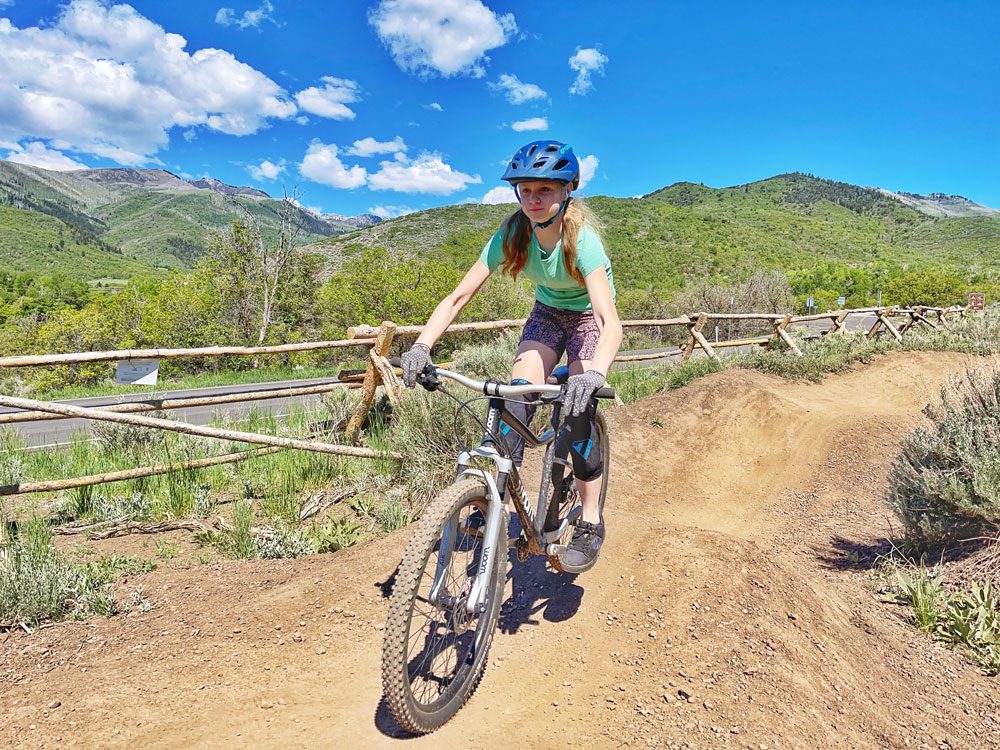
For these intermediate to advanced riders, the added weight is worth the boost in technical capability. The fork makes it easier to ride up and over roots, drop down ledges, and plow through chunky rock gardens, while also helping reduce fatigue.
Who is the woom OFF and OFF AIR not ideal for?
Due to their limited gear range, we don’t recommend the woom OFF and OFF AIR for kids taking on rides with over 500 ft. of elevation gain or those needing to tackle steep climbs. All models are 9-speed with a 28T chainring and an 11–32/34/36 cassette, depending on the size.

For those who need the extra gearing, the 10-speed Prevelo Zulu line is a better choice. Zulus have a 28T chainring and an 11–38/48 cassette, depending on the size. They also position riders in a more aggressive riding stance than the woom.
Also be aware that Prevelo’s size range is much smaller than woom’s. The Zulu 26” is almost the same size as the woom 24”. Our Bike Finder can help you determine the best size bike for both the woom and Prevelo models.
How lightweight is the woom OFF and OFF AIR?
The woom OFF series ranges from just under 19 lb. to 26 lb., depending on the model. The rigid woom OFF is by far the lightest kids’ mountain bike widely available. The OFF AIR models are lighter than bikes from major manufacturers and are on par with those from smaller brands, like Prevelo, which also come equipped with suspension forks.
When comparing weight, keep in mind that woom’s listed weights include pedals, while many other brands list weights without them. Additionally, the frame size of the woom OFF models are larger than the Prevelo Zulu bikes of the same wheel size.
woom OFF Weight Compare
| Bike | Weight (lb.) |
|---|---|
| 20" MTBs | |
| woom OFF 4 | 18.9 |
| Prevelo Zulu 3 | 20.5 |
| woom OFF AIR 4 | 21.7 |
| Specialized Riprock 20" | 22 |
| 24" MTBs | |
| woom OFF 5 | 21.6 |
| Prevelo Zulu 4 | 22 |
| woom OFF AIR 5 | 23.9 |
| Specialized Riprock 24" | 24 |
| Giant Talon 24 Disc | 26.1 |
| 26" MTBs | |
| Prevelo Zulu 5 | 23.3 |
| woom OFF 6 | 24.6 |
| woom OFF AIR 6 | 25.8 |
| Giant STP 26 | 27.6 |
These weights really stand out when considered in relation to the rider’s body weight. For example, when our very tall 4-year-old upgraded to a 20″ mountain bike, she weighed 50 lbs. At her weight, the woom OFF 4 was about 38% of her body weight while the Specialized Riprock, which is just over 3 pounds heavier, would have accounted for 44%. That’s a significant difference when you’re talking about young kids—and it makes climbing and longer rides noticeably more difficult.
Where can I see a woom in person?
Although woom is primarily a consumer-direct brand, their bikes are available in many stores throughout the U.S. Many REI locations, as well as select independent bike shops, have woom models available on the floor. You can use woom’s Store Locator to see if a shop near you carries the woom OFF models for in-person testing.

woom OFF AIR Full Review – Results of our Test Rides
Considering how much there is for new riders to take on when hitting the trails, the woom OFF is the perfect companion to help them build confidence while learning new skills and lingo. Whether tackling singletrack for the first time or trying out baby drops in the park, the woom OFF is ideal for both budding and intermediate riders. We put the OFF to the test with riders of various skill levels to see how it performed.

Woom OFF with Beginners
For our beginner riders, the OFF was the perfect bike—not too much (no suspension to save on weight), but not too little (enough gears and powerful hydraulic disc brakes). The woom OFF performed exceptionally well across the wide range of trails our beginning riders tackled.
Our 4-year-old tester on the woom OFF 4 was all smiles riding flowy trails in Bentonville, Arkansas. Being tall for her age, the OFF 4 was just enough bike for her—without being too much.
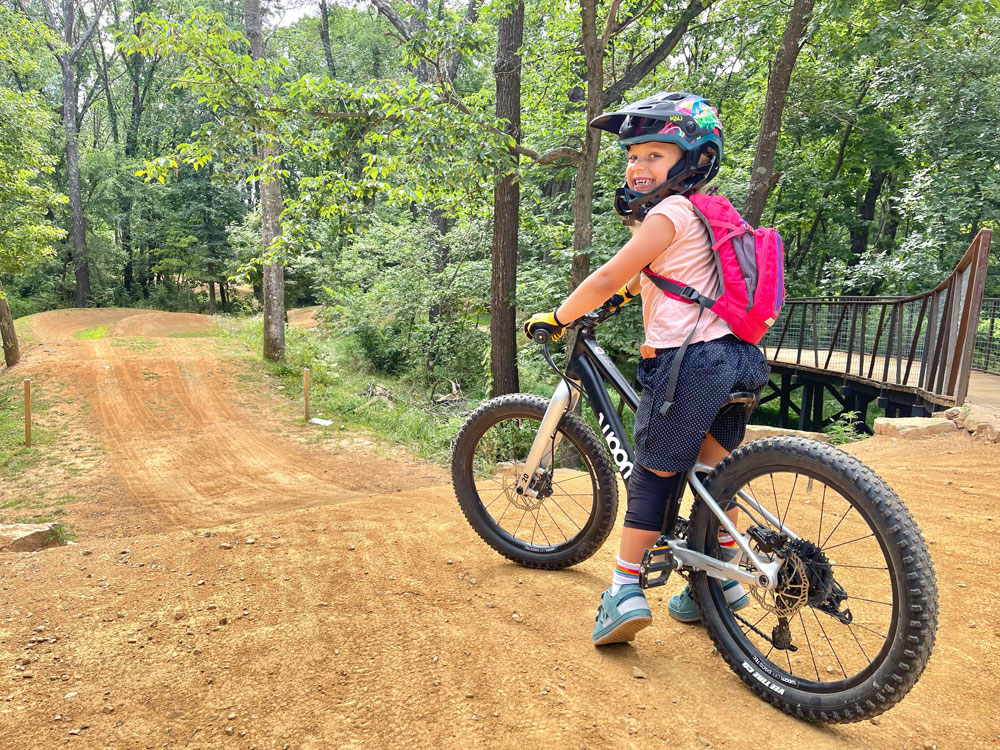
With a lot to take on at her age, the woom was her steady companion. While we still had to prompt her to shift (standard practice for all young riders on geared bikes), the bike never stood in her way of enjoying the ride. That said, we made sure she was confident and comfortable on the bike before hitting the singletrack.
In the Wasatch Mountains of Utah, the woom OFF easily handled green singletrack, mild chunk as well as the dry “moondust” dirt. With the wheels converted to tubeless, running at a lower PSI really helped cushion the rough bits.
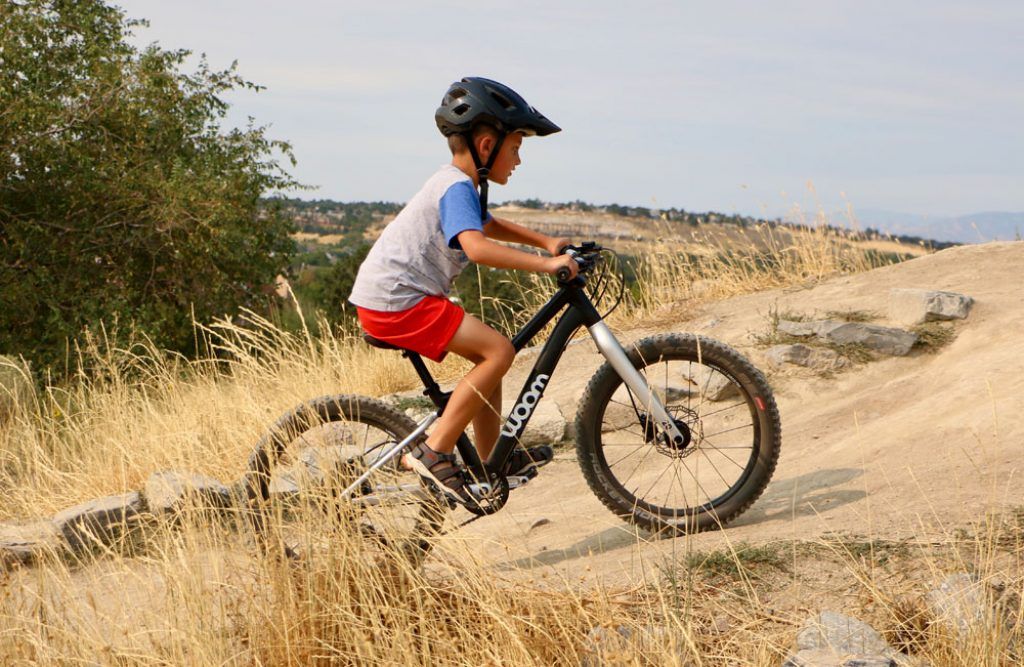
While all of the testers shown in these photos eventually moved up to the woom OFF AIR, we had no hesitation starting them off with the rigid woom OFF. We felt the lighter weight was more beneficial, helping them progress their basic skills more quickly.
Plus, considering most young riders—especially those on the 20” and 24” models—outgrow their bikes so quickly, by the time they’re ready to take on more advanced trails, they’ll also be ready for a larger wheel size. At that point, you can always upgrade them to the OFF AIR.
With the 26” woom OFF, however, if your goal is to get them onto more technical terrain, we recommend starting off with the woom OFF AIR. The woom OFF 6 offers quite a bit of room for growth, so kids typically ride it for a few years—versus just one or maybe two on the 20” and 24” models.
Woom OFF AIR with Intermediate and Advanced Riders
Our experienced 12-year-old tester on the woom OFF AIR 6 is a textbook example of how a lightweight mountain bike can benefit a kid. We quickly noticed that on the woom, he was much faster on the climbs compared to his previous, heavier bike.

The OFF AIR seemed like it just wanted to accelerate uphill. The bike chews through tight corners and switchbacks on climbs with ease and just seems to dance its way through tight technical spots. It was almost as if he were riding an e-bike—we actually had to work to keep up with him on the climbs.
Its lightweight and short rear end also made it easy for him to lift the front wheel up and over obstacles. Having completed the same trail countless times before, he was quick to point out the benefits of the woom while climbing. He felt the bike was faster and easier to maneuver.
On the descent, the woom didn’t hesitate and felt right at home through chunky terrain and bermed corners. Our testers also felt that the lighter weight of the woom made it easier to jump and pop over roots and rocks.

On the flip side, when it came to really steep and technical downhill sections, our tester felt much more confident on the more slack Prevelo Zulu Five. Considering the Zulu is designed to be a “trail” mountain bike and the woom OFF AIR a “cross-country” mountain bike, it was great to hear that his feedback aligned with the bikes’ intended designs.
Limited Gear Range
As he progressed to more advanced trails with greater elevation gain and joined his local NICA team, we also began to notice the limitations in the woom OFF’s gearing. The 11–32T rear cassette didn’t provide him with a low enough climbing gear. Considering he was riding in the Salt Lake Valley, where extensive climbs are commonplace, the gearing eventually became problematic.
While we were able to swap out the cassette and use a new derailleur, the shifter was much harder to use, so the setup wasn’t ideal. As a result, if you plan on riding extensive climbs, be aware of the woom OFF’s limitations.
The Prevelo Zulu line offers a much better gear range, but their frames are also significantly smaller—and he had become too tall for the Prevelo Zulu Five 26”.
Since climbs are inevitable on most mountain biking adventures, we highly recommend bringing a TowWhee tow rope on every ride with young riders. The TowWhee is easy to use, easy to stash in a backpack, and can be the difference between a happy, motivated rider and a tearful, frustrated one.

woom OFF’s Sizing
When purchasing a mountain bike, getting the right size is essential. Too small, and the child’s center of gravity will be too high and the wheelbase too short, increasing the risk of a crash.

Too big, and the bike becomes much more challenging to maneuver, and they’re more likely to injure themselves on the bike’s top tube during a crash. While it may be tempting, don’t buy a mountain bike with the idea that your child will grow into it. Buy the size they need with the knowledge that all quality kids’ mountain bikes have great resale value.
Also, don’t assume you know the size they need based on the bike they’re currently riding or just outgrew. Seat heights on kids’ bikes vary widely, even within the same wheel size, as shown in the table below.
woom OFF AIR Sizing
| Bike | Seat Height |
|---|---|
| 20" MTBs | |
| Prevelo Zulu 3 | 21.7” - 26.1" |
| woom OFF 4 | 22.8" - 28.7" |
| Specialized Riprock 20" | 25" - 30" |
| 24" MTBs | |
| Prevelo Zulu 4 | 24.8” - 31.1" |
| Specialized Riprock 24" | 27" - 32.5" |
| woom OFF 5 | 28.3" - 34.3" |
| 26" MTBs | |
| Prevelo Zulu 5 | 27.6” - 35" |
| woom OFF 6 | 30.7" - 38.2" |
As a result, it’s very important to measure your child’s inseam before purchasing a bike to ensure you get the right size. A properly sized bike will allow your child to touch the ground with both of their tippy toes while seated on the saddle.
Depending on how large your child’s feet are, the bike’s minimum seat height should be at least 2” to 4” taller than their inseam.
Geometry: Woom OFF vs. Prevelo Zulu vs. Specialized Riprock
Beyond seat height, it’s important to also understand bike geometry, which determines a child’s body position on the bike. More advanced riders typically prefer bikes with lower handlebars. This allows the rider to lean forward, which lowers their center of gravity and improves their ability to shift body weight while riding. More timid riders tend to prefer a more upright position, which keeps their center of gravity aligned over their hips—something that feels more natural, like when standing.

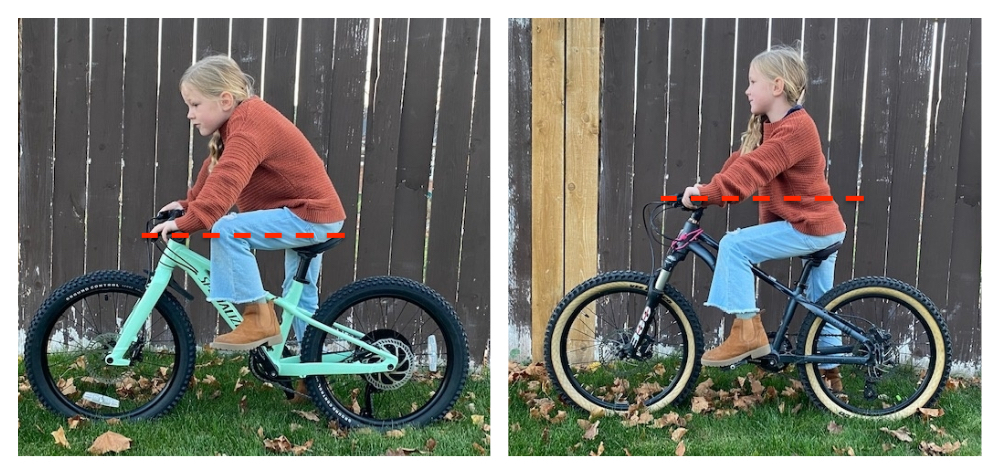
The woom’s more upright position is one of the main reasons we recommend it for beginning and hesitant riders. Prevelo bikes have a slightly more aggressive geometry than woom, while Specialized bikes are substantially more aggressive than both (see comparison examples below).
The differences between these models vary slightly by size but remain fairly consistent across each brand’s lineup. When selecting a bike, keep in mind that most kids starting out on a 20” mountain bike prefer a more upright position.
As they move up to a 24” or 26”, kids who ride more aggressively on technical terrain may prefer bikes with a more aggressive position, while others continue to feel more comfortable sitting upright. Also remember: a properly fitted bike is more important than geometry alone, so both should be taken into consideration.
20” Bikes Comparison
The Specialized Riprock 20 (red bike shown below) has a very aggressive geometry, which is why we don’t recommend it for most riders. Newer riders often feel uncomfortable on it, and kids tend to outgrow it quickly. The arrows in the images point to the center of the handlebars to highlight the difference in front-end height between the bikes.

In the image below, you can see how much lower our tester’s hands are in relation to her waist on the Specialized 20” compared to the Prevelo Zulu. Both bikes have 20” wheels and the same seat height, but the low stack height of the Specialized puts her in a much more aggressive riding position.
24” Bike Comparison
The 24” Specialized is still very aggressively positioned. The handlebar heights between the woom and Prevelo are similar, but the woom has a longer reach and a higher seat height range, allowing for more growth.

Like the 20” models, the Specialized 24” has a lower handlebar height, which positions the rider more aggressively compared to the woom and Prevelo. This more aggressive stance requires riders to lean forward and place more weight on the handlebars. While this can benefit more advanced or aggressive riders, it is often uncomfortable for many children. The lower handlebar height also limits room for growth on the bike.
26” Bike Comparison
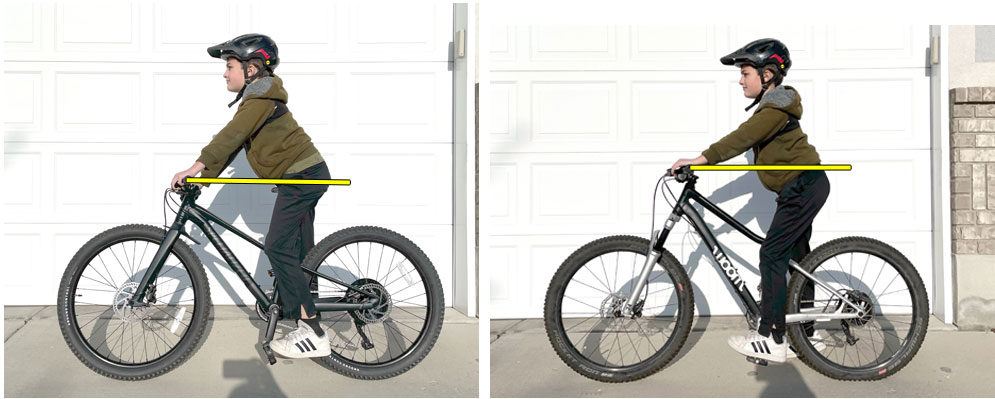
Specialized does not make a 26” mountain bike, so we can’t compare it directly to the Prevelo and woom. However, the seat height range of the Prevelo 26” is actually smaller than that of the woom OFF 24”. Like the 24’s, the Prevelo 26” also has a shorter reach than the woom 26”. As a result, if you’re looking for a slightly more aggressive 24” bike with a better climbing gear than the woom 24”, the Prevelo 26” is worth considering.

The smaller frame size of the Prevelo is evident in the comparison photo below. Our 11-year-old tester is just starting to fit the woom 26”, but is already nearing the end of the ideal fit range on the Prevelo 26”. The difference in reach between the two bikes is particularly noticeable when comparing the distance from the rider’s knee to the handlebars. There is significantly more space between the rider’s knee and the handlebar on the woom than on the Prevelo.

woom OFF’ AIR ’s Components
Real parts made for real riding, woom specced the OFF series with quality components, while also keeping price point and weight in mind.
Promax Hydraulic Disc Brakes
Brakes are hydraulic Promax stoppers, with 140mm front and rear rotors on the OFF 4, and larger 160mm rotors on both the front and rear of the OFF 5 and 6. The Specialized Riprock models also feature Promax hydraulic disc brakes.

The Prevelo Zulu line, on the other hand, uses Tektro brakes instead of Promax—but that’s also reflected in the price difference between the two brands.
SRAM X5 Drivetrain
The drivetrain is a SRAM X5 1×9 with a 28T front cog and a cassette that increases in range depending on the bike’s size: 11–32/34/36 for the OFF 4, 5, and 6. As mentioned previously, the gear range works well for most riders tackling mild to moderate elevation gains under about 500 feet.
However, when taking on climbs with very steep pitches or elevation gains over 500 feet, we found the OFF’s gearing to be limited—especially compared to the Prevelo Zulu, which features a 10-speed drivetrain with a 28T chainring and an 11–38/48 cassette, depending on the size.

The trigger shifter on the woom uses a double-thumb setup that is easy to operate and sensitive enough for smaller hands to manage. That said, in our head-to-head testing, the Prevelo Zulu’s Microshift shifter was slightly easier to engage.
Nice short cranks (110/130/150 mm for the OFF 4/5/6) with a narrow Q-factor create a kid-specific stance when pedaling and when standing with level pedals. They strike the perfect balance: wide enough for a steady base, but not so wide as to be uncomfortable for a child’s narrow hips.

woom OFF AIR Proprietary Suspension Fork
The AIR models come with an air suspension fork with 60mm/80mm/90mm travel depending on the size. All forks have a thru axle, adjustable compression, rebound damping and lock out.

woom’s proprietary air fork (made by RST) is lightweight and works really well. Due to the light weight of young riders, quality air suspension forks for kids are hard to come by. One common issue with cheaper air forks is that lowering the pressure enough for lightweight riders often results in a fork that doesn’t have enough air in the chamber to properly extend or rebound.

That luckily wasn’t the case with the RST shock on the AIR models. Once we properly adjusted the PSI, the fork provided plenty of cushioning, even at lower pressures. The adjustable compression was also a huge benefit for our younger, lightweight riders.
Lastly, the stanchions slide effortlessly through the lowers with a super smooth feel and little to no stiction (that essential friction for control).
Travel vs. Other Brands
The woom OFF AIR models have less travel than similarly sized bikes in the Prevelo Zulu line. The Specialized Riprocks, by comparison, do not come with a suspension fork at all.
The Prevelo Zulu models offer more suspension travel as the bike size increases—80mm on the Zulu 3, and 100mm on both the Zulu 4 and 5—compared to 60mm, 80mm, and 90mm on the woom OFF AIR 4, 5, and 6.
Considering the woom OFF AIR is designed more as a cross-country bike and the Zulu as a trail bike, the difference in travel makes sense. That said, unless your child is regularly hitting larger drops or jump lines, we don’t believe the added travel on the Zulu should be a major deciding factor. For lightweight riders, the real-world impact of that difference is relatively minimal.
Do keep in mind, however, that the woom OFF AIR bikes use a 1 1/8″ – 1″ baby taper steerer tube, which prevents swapping out their air fork for another brand.
Very Narrow Grips for Kids’ Hands
The OFF models feature a tapered handlebar that allows for smaller-diameter grips, making it easier for small hands to hold on securely and comfortably. The difference is especially noticeable when compared to the older version of the woom OFF.

In addition to being more comfortable, the grips include a bumper at the end to help protect hands in a crash, prevent hands from slipping off, and encourage proper hand placement.
While our testers loved these super small grips, their sizing (due to the tapered handlebar) does make it difficult to upgrade to grips from a different brand or in a different color.
Tubeless Ready Rims and Tires
The OFF models come equipped with 2.35″ Schwalbe Rocket Ron tires with the performance ADDIX SPEED compound, which provides plenty of grip and cushioning. Over the last several years, our testers in Utah have put hundreds of miles on the Rocket Rons without any issues. While our testers in Texas experienced some concerns with the thinner sidewalls, converting the bikes to tubeless resolved those problems.

Since both the rims and tires on the OFF models are tubeless compatible, converting them is simple. You’ll just need to tape the rims, replace the Presta valves, and add sealant. Here’s what we used:
As with any bike, remember not to over-inflate your child’s tires. Running a lower PSI helps maximize traction and cushioning, making the ride feel more planted and supple and significantly reducing the sting from rough trails.
Routed for a Dropper Post
The frames of the OFF 5 and OFF 6 allow for partial internal routing of a dropper post. woom does not offer a dropper post, so you will need to make the upgrade yourself if you choose to add one.
While we support customizing a mountain bike to match your child’s unique riding ability and style, keep in mind that the vast majority of kids do not need a dropper post. It is great that you can easily add one, but that does not mean your child needs it.
Some young riders may benefit from the ability to lower their saddle mid-ride, especially on descents whether short or long. Whether your child is ready for that added complexity is up to you, but this is more likely with older kids on the OFF 6.
Even if your child could benefit from a dropper post, remember that installing one affects the seat height of the bike. Since kids’ bikes have smaller frames, a fully extended dropper post is often taller than what a child can safely manage unless they are in the medium to upper end of the bike’s fit range.
For example, we installed the PNW Rainier 27.2 Dropper with 100mm travel on our woom OFF AIR 6. The dropper was easy for our testers to use and provided the right amount of travel, but it also increased the bike’s minimum seat height from 30.7″ to 35.5″.

Our tester was tall enough, so it wasn’t an issue. However, if a shorter rider were to accidentally engage the dropper post to full extension during a ride, they might not be able to touch the ground or even reach the pedals, which would be a huge safety concern.
Also keep in mind that because kids have shorter inseams, the usable travel on a dropper post will be minimal. As a result, dropper posts typically work best for taller kids who are at the upper end of a bike’s ideal fit range and have plenty of seatpost exposed.
Integrated Chainstay Protector

To prevent dents and dings from chain slap, the OFF’s come equipped with an integrated chainstay protector. The rubberized guard blends seamlessly into the frame and covers the entire length of the chainstay.
Stock Pedals Work Well

The OFF models come with a solid pair of stock pedals featuring small, non-threatening pins. They still provide plenty of grip, especially when paired with 5-10’s or Ride Concept flat pedal mountain bike shoes.
woom OFF and OFF AIR Bottom Line
Our verdict on the woom OFF and OFF AIR? Two enthusiastic thumbs up and two big fist pumps. Whether you go with the rigid OFF or the suspension-equipped OFF AIR, both bikes are exceptionally lightweight, well-balanced, and confidence-inspiring on the trail.
The rigid OFF is ideal for newer or more timid riders, helping them master the basics without being weighed down by unnecessary components. The OFF AIR adds a responsive air fork for more aggressive riders ready to take on chunkier terrain, flow trails, and moderate descents.
FTC Disclosure: Affiliate links are included in this review. No monetary compensation was provided for this review, however, the reviewed product was supplied by the manufacturer or distributor to help facilitate this review. All opinions and images are that of Two Wheeling Tots LLC. All content and images are copyrighted and should not be used or replicated in any way. View our Terms of Use.
