

The Best Balance Bikes for Kids of All Ages

Looking for the perfect balance bike for your little one? We’ve got you covered! Over the last decade, we’ve tested over 100 balance bikes with dozens of kids, and our experience is unmatched.
Through this testing, we’ve gained key insights into what really matters when choosing the best bike for your child. Whether your little one is just learning to walk or an anxious preschooler, we’ve found a great bike for them.
Balance bikes come in various sizes, so they’re not one-size-fits-all. To find the best fit, consider both your child’s age and the bike’s seat height (details provided in the Mini Reviews of each bike below or in our Kids Bike Finder Tool). Also be aware that balance bikes are NOT required to meet standard bike safety regulations, so be cautious with no-name budget bikes.
The Best Balance Bikes for All Ages
| Best for Young Toddlers - 18 months to 2 years old | ||
| Retrospec Cub | Budget Pick | $79 |
| Retrospec Cub Plus | Mid Price Pick | $129 |
| woom GO 1 | Best Overall | $249 |
| Prevelo Alpha Zero | Best for Playful Riders | $259 |
|
Best for Toddlers - 2 to 3 years old |
||
| Yedoo Too Too | Budget Pick | $99 |
| Strider Sport | Mid Price Pick | $139 |
| Guardian | Best Color Options | $149 |
| Biky Air 12 | Best Quality | $199 |
|
Best for Preschoolers - 3 to 4 years old |
||
| Radio Flyer Ultra Lite | Budget Pick | $99 |
| Retrospec Cub Plus XL | Mid Price Pick | $149 |
| woom GO 1 Plus | Best Overall | $299 |
| Best for PreK - 4 to 6 years old | ||
| Strider 14x | Best for Shorter Kids | $229 |
| Want a balance bike with pedals? Check out our Convertible Balance Bikes list. | ||
What is a balance bike?
Never heard of a balance bike? Let us introduce you! A balance bike, also known as a strider bike, glider bike, running bike, or toddler push bike, is a pedal-less bicycle with two wheels. Balance bikes are designed to teach children the art of balancing on two wheels, setting them on the path to independent riding.
Can I get a cheap balance bike?
Due to their simple design, there are a larger range of cheap balance bikes on the market. While some offer great value, many come with significant drawbacks. Since balance bikes are NOT required to meet standard bike safety regulations, be very cautious with no-name budget bikes. To help you make a safe and smart choice, we’ve included reliable budget-friendly picks in our recommendations.
What about convertible balance bikes?
Several companies make balance bikes that can convert into pedal bikes. While these bikes can save you money, like most “2-in-1” products they often perform better in one mode than the other. That said, there are a few standout exceptions worth considering. You can find our roundup of the best convertible balance bikes further down on this page.
Balance Bike Buying Tips
1. Balance bikes are NOT one-size-fits-all. Measure your child’s inseam and compare it to the seat height of the bike. Look for a bike with a minimum seat height that is equal to, or slightly less than, your child’s inseam.
2. Air tires are better than foam tires. Opt for air tires over foam tires for better cushioning and traction, especially if riding on surfaces other than pavement.
3. Hand brakes are not required, but highly recommended. Kids naturally learn to stop a balance bike with their feet. As they get older they can learn to use a hand brake, which helps them stop faster and saves money on buying new shoes! For older and more aggressive riders, a hand brake becomes more essential.
4. Stick to two wheels! A “baby balance bike” is not a true balance bike as it has four wheels and can’t teach a child to balance. For young toddlers, they can be benefical as they introduce the idea of sitting and propelling yourself forward with your feet at an even younger age.
5. Jump down to our FAQ section at the end of the page to get answers to more frequently asked questions about balance bikes.
BIKES FOR YOUNG TODDLERS – 18mo+
18 months or 2 years old is a perfect time to start a toddler on their balance bike journey. Introducing a balance bike early will allow your toddler to learn to ride independently from the very start. With little ones, a lightweight bike is especially key!

woom GO 1
$249
FITS KIDS: In 18-months pants to 3T. For a larger option, check out the woom GO 1 Plus.
SEAT HEIGHT: 10″ to 14″
WEIGHT: 6.3 lb.
FEATURES: Air tires, hand brake, quick release seat post, and turning limiter
Pros:
Cons:
What We Love About the woom GO 1
The woom GO 1 is the lastest edition to the beloved woom 1 balance bike. Perfection from top to bottom, the woom GO 1 creates a smooth, easy ride for young or small toddlers getting an early start on their balance bike journey. To keep young ones at ease, the woom’s handlebars place the rider in a natural, upright position with their weight centered over their hips. This helps toddlers feel less hesitant about balancing.
This, combined with a lightweight, extremely low step-through frame, a low minimum seat height, extra-cushioned air tires, and an easy-to-use handbrake, allows the woom 1 to effortlessly take your child from walking along the sidewalk to ripping down trails. As an added bonus, the woom GO 1 is available in 5 colors!

Prevelo Alpha Zero
$259
FITS KIDS: 18 months transitioning to 3T clothes
SEAT HEIGHT: 10.75″ – 14″
WEIGHT: 6.86 lb.
FEATURES: All-terrain, cushioning air tires, easy pull hand brake, confidence building geo for playful and aggressive riders
Pros:
Cons:
What We Love About the Prevelo Alpha Zero
The Alpha Zero is a balance bike that’s built for kids who like to play hard. It’s light enough for toddlers to carry around on their own, but solid enough to hold up when they’re dragging it up a curb or dropping it on the driveway.
What really makes it stand out is the geometry. The offset fork and slightly set-back seatpost shift a child’s weight behind the front wheel, which gives them more control when rolling down ramps or tackling uneven ground. Paired with air tires that roll smoothly and cushion the ride, the Alpha Zero feels stable and confidence-boosting for little riders who want to try more than just the sidewalk.
Prevelo also pays attention to the small details—like recessed axle bolts, an easy-to-reach hand brake, and an integrated stem—that make the bike safer and more durable for everyday use. All of this makes the Alpha Zero a great fit for playful riders who are always looking for the next challenge.

Retrospec Cub and Cub Plus
$79 -Cub, $129 – Cub Plus
FITS KIDS: 18 months transitioning to 3T clothes
SEAT HEIGHT: 11.5″ – 15″
WEIGHT: Cub: 7 lb., Cub Plus: 8.7 lb.
FEATURES: Puncture-proof foam tires, quick release seat post and handlebar height adjustments, long wheelbase
CUB PLUS FEATURES: Cushioning air tires, hand brake
Pros:
Cons:
What We Love About the Retrospec Cub
With a low minimum seat height of 11.5″, the Retrospec Cub model are fantastic balance bikes for young toddlers eager to start their riding journey, even before turning two. Designed with room for growth, including height-adjustable handlebars, the Cubs allows your little one to quickly and comfortably get the hang of balance biking while cruising around the neighborhood.
Both the Cub and Cub Plus share the same frame design and fit the same size rider, but the Cub Plus offers some upgraded features. The Plus model has an aluminum frame, air-filled tires, and a hand brake, while the standard Cub comes with a steel frame, foam tires, and no hand brake.
If style is important to your little rider, the Cub is a standout with its selection of eight trendy and modern color options, compared to just two colors available for the Cub Plus.
BIKEs FOR TODDLERS – 2 TO 3 YEARS
These bikes are a little bigger that our smallest choices, and are sized to fit toddlers in at least 24 months pants. While toddlers won’t be able to use the handbrake until they are about 2.5, that feature is hugely beneficial as they get older and ride more aggressively.

Biky Air 12
$199
FITS KIDS: Toddlers in clothes sized 2T to transitioning to 4T
SEAT HEIGHT: 12.5″ to 15.5″
WEIGHT: 6.61 lb.
FEATURES: Air tires turning limiter, quick release seat post
Pros:
Cons:
What We Love About the Biky Air 12 Balance Bike
The Biky Air 12 strikes a rare balance of simplicity, performance, and thoughtful design that makes it ideal for petite or more cautious riders just starting out. Weighing just 6.6 lbs, it’s one of the lightest balance bikes on the market, light enough for even the tiniest toddlers in 2T pants to maneuver with ease. Its narrow grips, slim frame, and long wheelbase offer added control and stability, while the air-filled tires provide a smooth, forgiving ride on sidewalks, curbs, and packed dirt.
While the Guardian balance bike includes dual handbrakes and costs $50 less, it’s also 2 lbs heavier. For many toddlers, especially those not yet ready to use a handbrake, the Biky’s featherlight frame and intuitive handling are more impactful than added braking power. The Biky’s slim rear end also eliminates leg-scratching issues that are common with bulkier bikes. For families with smaller or less aggressive riders, the Biky Air 12 may be the better choice, even at a higher price point.

Guardian Balance Bike
$149
FITS KIDS: Toddlers in clothes sized 2T to transitioning to 4T
SEAT HEIGHT: 12.5″ to 16″
WEIGHT: 8.5 lb.
FEATURES: Air tires, SureStop hand brakes, turning limiter, quick release seat post
Pros:
Cons:
What We Love About the Guardian Balance Bike
With several fun, colorful designs to choose from as well as air tires, a handbrake, and a lightweight aluminum frame, there is a lot to love about the Guardian Balance bike. With a taller minimum and maximum seat height than the woom 1, the Guardian provides exceptional quality, but more room for growth for tall or older toddlers.
The Guardian balance bike features their proprietary SureStop braking system, which allows the rear and front rim brakes to be activated by pulling just one brake lever. During our tests, the Guardian provided plenty of top-notch stopping power to keep our little testers safe, but not significantly more than other high-end balance bikes with quality hand brakes.
As a result, while the Guardian balance bike is a stand-out option, the SureStop brakes shouldn’t play a major role in your purchasing decision if you’re comparing it to a balance bike with a high-quality single handbrake. (But the cute designs, top-notch customer service, and high-quality build should!)
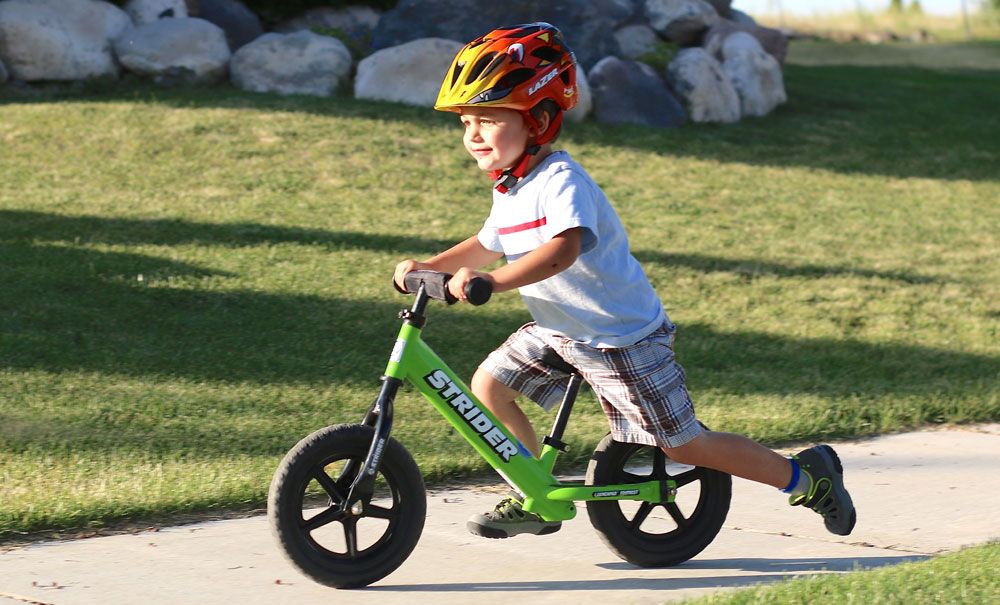
Strider Sport
$139
FITS KIDS: 18 months to 4-years-old
SEAT HEIGHT: 11″ to 17″
WEIGHT: 6.7 lb.
FEATURES: Foam tires, foot rest, adjustable height handlebars, quick release seat post
SPORT FEATURES: Narrow grip handlebar with pad, longer seat post, padded seat
Pros:
Cons:
Why We Love the Strider
Built on a well-designed frame, the Strider balance bike is easily adaptable to fit a wide range of ages. With an extended seat post and adjustable-height handlebars, we’ve had the best luck with Strider at accommodating kids of various sizes. For a decent price point, the Strider is a quality bike that fits light kids, heavy kids, tall kids, short kids – you generally can’t go wrong with a Strider.

Radio Flyer Ultra Lite
$115
FITS KIDS: Kids in 2T to 3T
SEAT HEIGHT: 12.6″ to 16.5″
WEIGHT: 7.25 lb.
FEATURES: Unique modern frame, cushioning air tires
Pros:
Cons:
Why We Love the Radio Flyer Ultra Lite
The Radio Flyer Ultra Lite stands out with its sleek, modern design that draws in kids and parents alike. Its eye-catching frame features iridescent paint and larger-volume air tires, making it a bike your child will be excited to ride.
But it’s not just about looks—the Ultra Lite delivers where it matters. With a smooth ride, a longer wheelbase for added stability, and a true headset to keep the handlebars properly aligned, this balance bike combines style and functionality seamlessly.

Yedoo Too Too
$99
FITS KIDS: Kids in 2T to 3T
SEAT HEIGHT: 12.5″ – 16.5″
WEIGHT: 8.3 lb.
FEATURES: Cushioning air tires, hand brake
Pros:
Cons:
What We Love About the Yedoo Too Too
The Yedoo Too Too stands out from many balance bikes in its class thanks to its lightweight aluminum frame, a welcome upgrade over the steel frames that dominate this price range. At just 8.3 lb, it’s easy for young riders to handle and far less cumbersome for parents to carry when little legs get tired.
This bike is clearly built to last, with thoughtfully chosen, high-quality components. The Kenda air tires provide real cushioning and grip, making rides smoother and more confidence-inspiring than solid or foam tires. Even more impressive is the inclusion of a Tektro hand brake, which is still rare on balance bikes. It works exceptionally well, giving kids reliable stopping power as they gain speed and control.
We also appreciate the narrow saddle, which fits comfortably between smaller legs and allows for a more natural riding position. Combined, these details make the Too Too feel less like a toy and more like a true first bike, designed to grow with confident, fast-progressing riders.
BIKES FOR PRESCHOOLERS – 4 TO 5 YEARS
For riders who are starting their balance bike journey a little later, you’re looking for a longer wheelbase to give them more room to stretch out on the bike, as well as wider handlebars for more stable maneuvering. A handbrake is also highly recommended at this age, as older kids can reach much higher speeds.

woom GO 1 Plus
$299
FITS KIDS: Fits kids in 3T to 5 pants
SEAT HEIGHT: 14.8″ to 18.7″
WEIGHT: 9.6 lb.
FEATURES: Air tires, dual handbrakes, turning limiter
Pros:
Cons:
Why We Love the woom GO 1 PLUS
One of our favorite balance bikes made bigger, the woom GO 1 Plus has all the benefits of the popular woom 1, but for kids ages 3 to 5. It’s the perfect bike for timid kids starting off their balance bike journey as preschoolers versus toddlers.
With comfortable, upright body positioning, large 14″ air tires, a removable “surfboard” footrest and turning limiter, and DUAL hand brakes (a rare find in balance bikes), the woom GO 1 Plus is the ultimate confidence-building, larger balance bike.
Keep in mind that with its taller handlebars, the woom GO 1 Plus is best for timid and casual neighborhood riders. Kids who will likely be tackling pump tracks won’t be able to lean in far enough to get aggressive.

Retrospec Cub Plus XL
$139
FITS KIDS: Kids in 3T to 5T pants
SEAT HEIGHT: 15″ to 21″
WEIGHT: 10.3 lb.
FEATURES: Cushioning air tires, dual hand brake, quality construction
Pros:
Cons:
Why We Love the Retrospec Cub Plus XL
Perfect for taller toddlers or kids starting their balance bike journey at age 2 or 3, the Retrospec Cub Plus XL offers a smooth, budget-friendly introduction to biking.
With a 6″ seat height range and a longer wheelbase, it gives growing riders plenty of room to stretch out and build confidence. The air-filled tires provide great cushioning and traction, while dual hand brakes help kids safely learn proper braking technique. An aluminum frame and plush saddle round out this solid, thoughtfully designed ride.

Radio Flyer Air Ride
$79
FITS KIDS: Kids in 2T to 3T pants
SEAT HEIGHT: 13″ – 17″
WEIGHT: 7.6 lb.
FEATURES: Air tires on sturdy metal rims, adjustable height handlebar
Pros:
Cons:
Why We Love the Radio Flyer Air Ride
The Radio Flyer Air Ride Balance Bike is one of the best budget-friendly options for preschoolers ready to learn to ride. Unlike most entry-level balance bikes, the Air Ride comes equipped with real air-filled tires offering better traction, cushioning, and control on a variety of surfaces. Its taller seat height range (13″–17″) makes it a great fit for older toddlers and preschoolers compared to other models.
We also appreciate its thoughtful design touches, like a quick-release seat post clamp for easy height adjustments and a longer wheelbase that helps kids feel stable and balanced as they ride. While the lack of a handbrake and the basic handlebar setup remind you it’s a budget pick, the Air Ride still delivers excellent geometry and performance for its price point.
If you’re looking for an affordable balance bike that rides more like a “real” bike than a toy, the Radio Flyer Air Ride is a fantastic choice.

Banana Bike GT
$79
FITS KIDS: Kids in 2T to 4T pants
SEAT HEIGHT: 13″ – 17″
WEIGHT: 8.4 lb.
FEATURES: Wider wheelbase, air tires with metal rims, adjustable height handlebar
Pros:
Cons:
What We Love About the Banana Bike GT
The Banana Bike GT is a solid budget-friendly balance bike for older and taller toddlers. Its geometry offers more room to grow compared to many entry-level balance bikes and the handlebars are height adjustable.
While Banana Bike also offers a cheaper LT version, we strongly prefer the GT. The upgrade to air tires makes a noticeable difference in ride quality, providing better cushioning, improved traction, and a smoother experience on sidewalks, paths, and rougher pavement. That extra comfort goes a long way for bigger riders who tend to ride faster and cover more ground.
Overall, the Banana Bike GT delivers excellent value by combining kid-friendly geometry with practical upgrades where they matter most, making it a smart choice for families looking for an affordable balance bike that works especially well for taller toddlers.
BIKES FOR PREK – 4 TO 6 YEARS
Is a four-year-old too old for a balance bike? No way! Is a six-year-old too old for a balance bike? Also no way! Balance bikes are so much fun to ride, and are a far better experience than a pedal bike with training wheels.
For these larger balance bikes, along with bigger 14″ wheels, you also want a longer wheelbase and wider handlebars for the best fit and maximum stability.

Strider 14x
$229
FITS KIDS: Best for ages 4 to 5 with inseams 17″ to 20″
SEAT HEIGHT: 15″ to 22″
WEIGHT: 12.5 lb.
FEATURES: Air tires, lots of room for growth, optional pedal bike kit
Pros:
Cons:
Why We Love the Strider 14x
The Strider 14x has gained fame for being a larger balance bike that converts to a pedal bike. No need for training wheels, once a child has learned to balance while in balance bike mode, simply put on the pedals and within a couple of minutes they’ll be pedaling away! Once your child outgrows the pedal bike mode, they will be ready for a 16″ bike.
Based on our testing, the pedal bike mode of the Strider 14x is a very temporary solution, and a child will need a true 16″ pedal bike pretty quickly. As a result, we don’t generally recommend the optional pedal kit, but do like the Strider 14x as a larger balance bike.

Ridgeback Scoot XL
$299
FITS KIDS: In size 4T to 7 pants
SEAT HEIGHT: 16″ – 21.5″
WEIGHT: 11.6 lb.
FEATURES: Air tires, hand brake, quality construction, large frame for growth
Pros:
Cons:
Why We Love the Scoot XL
The Ridgeback Scoot XL is the bigger brother of the Ridgeback Scoot. These two bikes are almost identical, except for their size. The larger, taller frame of the Scoot XL is better scaled for taller kids. The adjustable handlebar height is also a bonus for kids who need to ride the Scoot XL until they are 6 or 7 years old.
BALANCE BIKE COMPARISON CHART
This chart lists balance bikes from the lowest to the tallest minimum seat height. Because fit is critical, we strongly recommend measuring your child’s inseam before buying. Ideally, the bike’s seat should be set about an inch lower than your child’s inseam for the best fit. To keep the chart simple, we’ve left out details like tire type (air vs. foam) and brakes—be sure to check our mini reviews of each model for those specifics.
| Balance Bike | Seat Height | Weight |
|---|---|---|
| woom GO 1 | 10.1” – 14″ | 6.5 lb. |
| Prevelo Alpha Zero | 10.75” – 14″ | 6.9 lb. |
| Strider Sport | 11.0” – 17″ | 6.7 lb. |
| Retrospec Cub Plus | 11.5” – 15″ | 8.7 lb. |
| Retrospec Cub | 11.5” – 15″ | 7 lb. |
| LittleBig Convertible | 12” – 20″ | 10.2 lb. |
| Biky Air 12 | 12.5” – 15.5″ | 6.6 lb. |
| Guardian | 12.5” – 16″ | 8.5 lb. |
| Radio Flyer Ultra Lite | 12.6” – 16.5″ | 7.3 lb. |
| Banana Bike GT | 13.0” – 17″ | 8.4 lb. |
| woom GO 1 Plus | 14.4” – 17″ | 9.8 lb. |
| Retrospec Cub Plus XL | 15” – 21″ | 8.7 lb. |
| Strider 14x | 15” – 22″ | 12.5 lb. |
| Ridgeback Scoot XL | 16” – 21.5″ | 11.6 lb. |
CONVERTIBLE BALANCE BIKES WITH PEDALS
Convertible bikes generally fall into two categories: balance bikes that convert to pedal bikes, and pedal bikes that convert to balance bikes. In most cases, balance-to-pedal models perform better as balance bikes, while pedal-to-balance models tend to work better in their pedal form.
Balance Bikes that Convert to Pedal Bikes
These start as balance bikes and later add pedals. They perform better in balance mode than pedal mode. We generally only recommend them for athletic toddlers who begin riding around age 2 and are likely to progress to pedals quickly. Older toddlers and preschoolers often outgrow the bike’s frame before they reach the pedal bike stage.

LittleBig Convertible
$295
FITS KIDS: Kids in 2T to size 5 clothes
SEAT HEIGHT: 12” – 20″
WEIGHT: 10.21 lb. (balance bike mode), 13.82 lb. (pedal bike mode)
FEATURES: Three frame modes (small and big balance bike, pedal bike), air tires, dual hand brakes, no coaster, quality build
Pros:
Cons:
What We Love About the LittleBig
The LittleBig is a true three-in-one: it starts as a small balance bike, adjusts into a larger balance bike, and later converts into a pedal bike. Built to a high standard, it features dual hand brakes and no coaster brake, a big plus for young riders learning proper braking skills. While attaching the pedal assembly can take a bit of patience to get everything lined up correctly, it does come off as a single unit, and the chain is removed separately. This makes it easy to take apart and store until your child is ready to pedal.

Strider 14x
$249 + $89 pedal assembly
FITS KIDS: Taller 3-year-olds to 5-year-olds
SEAT HEIGHT: 15” – 22″
WEIGHT: 12.5 lbs. (balance bike mode)
FEATURES: 4 plastic/foam wheels, steering
Pros:
Cons:
What We Love About the Strider 14x
The Strider 14x shines as a balance bike but is less impressive once converted to pedals. With its 16″ wheels, it’s a solid choice for taller preschoolers who may need extra time before pedaling. However, the short crank arms and included coaster brake (part of the separate pedal kit) make it less efficient and less fun to ride in pedal mode. In our testing, kids enjoyed the balance setup but were eager to move on to a true pedal bike once ready.
Pedal Bikes that Convert to Balance Bikes
These are designed first and foremost as pedal bikes. While you can turn any pedal bike into a “balance bike” by removing the pedals, this leaves the crank arms in place and can interfere with a child’s stride. The extra weight of the drivetrain is also a drawback. True convertible systems solve these issues more cleanly.

Prevelo Alpha One and Two
$489 (Alpha One), $509 (Alpha Two)
SEAT HEIGHT: 14.75″ – 19.75″ (Alpha One), 17” – 24.75″ (Alpha Two)
WEIGHT (as pedal bike): 12 lb. (Alpha One), 12.9 lb. (Alpha Two)
FEATURES: Lightweight build, exceptional quality, dual hand brakes, aggressive geometry
Pros:
Cons:
Why We Love the Prevelo Alpha One and Two
The Prevelo Alpha series stands out as one of the few pedal bikes that genuinely work just as well in balance mode. Thanks to Prevelo’s Balance-Tech system, the crank arms and drivetrain come off cleanly, leaving kids with a lightweight, easy-to-maneuver balance bike.
Both the 14″ Alpha One and 16″ Alpha Two feature low minimum seat heights, dual hand brakes without a coaster, and confidence-boosting geometry that makes the transition to pedals feel natural. In our testing, the Alphas performed equally well in both modes, giving kids a smooth start on two wheels and plenty of room to grow their skills as full-fledged pedal riders.
Prevelo also offers its Balance-Tech system in its Zulu mountain bike line. With hydraulic disc brakes and chunky MTB tires, these little rigs are perfect for young riders eager to hit singletrack and start riding like true groms.

RoyalBaby Magnesium
$350
SEAT HEIGHT: 20” – 25″
WEIGHT (as pedal bike): 14.5 lb.
FEATURES: Lightweight frame, pedals and cranks easily snap on and off bike
Pros:
Cons:
About the RoyalBaby Magnesium
The RoyalBaby Magnesium may look appealing as a lower-cost convertible option, but in practice it comes with several drawbacks. While its EZ system allows the pedals and crank arms to be removed for balance mode, the chain remains in place, adding unnecessary weight. The snap-on crank arms also push the pedals unnaturally wide, forcing kids to pedal with their legs splayed outward, which leads to an awkward and inefficient pedal stroke. On top of that, the bike’s minimum seat height is about three inches taller than the Prevelo’s, meaning kids need to be much bigger before they can even fit on it.
Balance Bike FAQ’s
We’ve tested and reviewed balance bikes for the past 15 years, and have had hundreds of parents ask us questions about them. Here are the answers to what we believe are the most important questions for those just starting on their balance bike journey.
This FAQ relates to 2-wheeled balance bikes only, not three or four-wheeled baby bikes or “pre-balance bikes”.
What is the best age for a balance bike?

To get the most use out of a balance bike, the best age to start a child is between 18 months and 2.5 years. Prior to 18-months, a baby balance bike, like the woom WOW, is a better option. Starting kids young will not only allow them to happily ride their bike independently for all of their toddler years, it will also allow them to move up to a pedal bike by age 3 or 4.
That said, there are balance bikes made for all sizes of toddlers, pre-schoolers, and grade schoolers, so it’s basically never too late to start. Remember… a balance bike will almost always be a better option than a tricycle or training wheels. If your child is at an age when you would consider either of these options, consider a balance bike instead!
Unlike tricycles and training wheels, toddlers can hop on a balance bike and start walking and scooting around from day one. They never come with push bars for adults to assist the child, as there is no use for them; one of the greatest advantages of a balance bike is that very young kids can ride them all on their own.
How many years do kids ride them?

Kids generally ride balance bikes for 1 to 2.5 years, depending on the age they start, their athletic ability, and their developmental readiness.
A child that starts at 18-months-old may take several months to sit and run confidently on their balance bike, but then spend the next year or two dominating the world on those two wheels.
Your average 2-year-old or 2.5-year-old will grasp the process more quickly, but may still spend another year or two enjoying the ride.
Remember… while a balance bike certainly prepares a child for a pedal bike, that’s not their only purpose. They are a ton of fun. There should be no rush to put a child on a pedal bike just because they are 3 or 4, or even 5 years old!
Less coordinated kids generally stay on a balance bike longer because it’s a simple little machine that’s easy and fun for them to maneuver. Don’t force the complexity of pedals onto a child that isn’t ready and who is still enjoying their balance bike!
What are the main benefits of a balance bike?
There are five main benefits of balance bikes over other types of bikes for toddlers. Balance bikes…
- Fit kids much better than tricycles or bikes with training wheels
- Move easily and safely over uneven surfaces
- Are light and easy to ride – kids can ride much farther
- Provide years of fun and independent riding before a child transitions to a pedal bike
- Eliminate the need for training wheels – balance bike graduates usually learn to ride a pedal bike in about 5 to 10 minutes, DRAMA FREE.
How do they compare to training wheels?
Training wheels significantly delay a child’s ability and desire to ride a bike. Balance bikes teach toddlers and kids how to ride while balanced, whereas training wheels teach how to ride while unbalanced.
Bikes with training wheels tilt to one side, creating a false sense of balance. In order to ride without the training wheels, a child must “unlearn” how to ride unbalanced and then learn how to ride while balanced.

On a balance bike, proper balancing techniques are learned from day one. One other thing to consider is that balance bikes are just more fun and much easier to ride than a bike with training wheels.
You can learn more about the pitfalls of training wheels on our page: Training Wheels: 10 Common Questions Parents Ask.
Are they better than a tricycle?
Balance bikes are much safer and more practical than tricycles. With three wheels, tricycles are slow, awkward to maneuver, and easily tip on uneven or angled surfaces. On a balance bike, children are focused on balancing, rather than pedaling. As a result, they are more prepared for an unexpected loss in balance and are much less likely to fall.

Toddlers can also walk or run for several miles on a balance bike, but can rarely make it to the end of a block on a tricycle. Tricycles are simply too inefficient for kids to ride long distances, which is why they often come with handles for parents to push.
You can read more about the debate between balance bikes and tricycles on our page: Balance Bikes vs Tricycles.
How do you ride one?

There are four stages to learning how to ride a balance bike. While some kids need a little instruction, most kids intuitively move through these stage on their own. So you don’t really “teach” a child to ride a balance bike. These stages simply help parents to understand what this process should look like.
- Stand and walk
- Sit and walk
- Sit and run
- Run, glide, and explore!
Perhaps the most important take away is that kids move through these stages at very different rates. Depending on age, athletic ability, temperament, and desire, the amount of time a child takes to “master” a balance bike varies greatly. For a much more detailed look at these stages, check out our article How To Ride a Balance Bike.
Where do kids put their feet?
Balance bikes do not require a footrest. Kids naturally pick up their feet as they are gliding. In all our years of testing, we have rarely had a child ask where to put their feet on the bike, but A LOT of parents ask that question :-).

Can I use a regular bike as a balance bike?
For kids ages 5 and up, removing the pedals of a regular bike is a good and affordable option, but is unpractical for toddlers and preschoolers. Pedal bikes are much heavier than balance bikes, making them more difficult to learn to balance.
It’s important to remember that balance bikes are more than simply the means to an end. While balance bikes DO prepare kids to ride a bike, they also offer toddlers years of fun and independence BEFORE they are tall enough to fit on the smallest pedal bike.
If you are considering taking the pedals off of a bike to use it as a balance bike, it’s best to do with older kids on 16″, 20″ or 24″ bikes. When a child is still small enough to fit on a 12″ or 14″ bike, even investing in a cheap balance bike would be a much better option. We discuss how to use a pedal bike as a balance bike here.

My child won’t ride his balance bike… what’s wrong?
Every child has a will of their own, and sometimes they just refuse to do what you want! It often takes younger toddlers several months to be consistently interested.
For example, at 18 months, our toddler walked with her balance bike for about 2 weeks. And then for 5.5 months she wouldn’t touch it! Miraculously one day, she just picked it up and started going. We haven’t been able to stop her since!
If your child doesn’t seem interested, keep the bike around so they can see it and use it when they feel the time is right. Resist the temptation to pressure them. We’ve seen time and again that kids will be interested when they want to be interested.
It can also be helpful to take your child somewhere that they can see other kids riding balance bikes. When they see other kids doing it, they realize that it’s not that hard and they want to be in on the fun!

Kids who have tricycles, scooters, or bikes with training wheels can be more resistant to ride a balance bike. Why? Balance bikes require a little more effort to learn but offer far greater rewards in return. If you think this might be the problem, remove these other distractions and only offer up the balance bike as a possibility.
Best case scenario, we encourage parents to not introduce a tricycle, training wheels, or scooter until after a child has mastered a balance bike.
Can you add pedals to a balance bike?
You cannot add pedals to just any balance bike, but there are a few balance bikes that are designed to convert to pedal bikes. The Strider 14x and LittleBig bikes are the two most common examples. These convertible balance bikes have optional pedal kits that can be installed when your child has mastered their balance bike and is ready to tackle pedals. These pedal kits only work with these bikes.
What should I look for when buying a balance bike?
While balance bikes seem simple, there are actually quite a few features you need to consider to find the perfect balance bike for your child.
For example, what size is the best fit? (Remember, they are not one-size-fits-all!!) Do you need air tires or foam tires? How much does weight matter? Is one brand better than another? We cover all these features and more in our Balance Bike Sizing and Buying Guide.
Related Articles
Balance Bike Sizing and Buying Guide: A more detailed discussion on how balance bike sizes work, and how to get the best fit.
woom WOW Baby Balance Bike Review: The self-balancing balance bike for babies as young as 9 months old!
FTC Disclosure: Affiliate links are included in this review. No monetary compensation was provided for this review, however, some of the reviewed products were supplied by the manufacturer or distributor to help facilitate this article. All opinions and images are that of Two Wheeling Tots LLC. All content and images are copyrighted and should not be used or replicated in any way. View our Terms of Use.
