

Guardian Bikes 14 Inch Review – Is it easier to learn on?
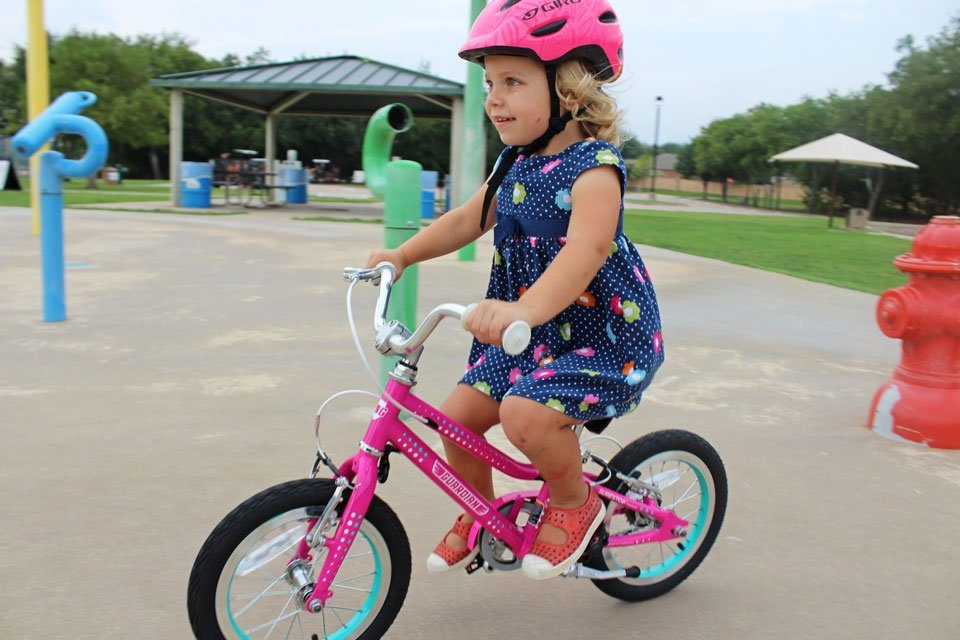
If you have a little balance bike master who is ready to start pedaling, the Guardian 14 is a great little bike for learning to pedal. Built with a confidence-inspiring frame, a longer wheelbase, and no coaster brake (the back-pedal brake that so often makes learning to pedal a challenge), the Guardian 14 is designed to make those first pedaling adventures as smooth as possible.
From what we love about the Guardian to what we think needs a bit of improvement, as well as how it compares to other brands, we’ll cover everything you need to know about the Guardian 14 in this review.
Why trust us? We’ve been reviewing kids’ bikes for over 15 years. We only review kids’ bikes, and we’ve tested over 30 different 12″ and 14″ bikes. We’ve been reviewing Guardian since before they went on Shark Tank, and they even mentioned us on the show!
Guardian Bikes 14
OUR SCORE: 71.5/100 – Recommended
MSRP: $269
BEST FOR: Kids with inseams ranging from 16″ to 20″, or approximately 3T/4T clothes.
SEAT HEIGHT: 16″ – 25″ (but comfortable up to about 21″)
WEIGHT: 16 lb. (with kickstand and pedals)
ADDITIONAL SPECIFICATIONS
BRAKES: SureStop Dual Hand
FRAME: Steel
GAIN RATIO: 3.95
TRAINING WHEELS: Compatible, but no included
What We Love About the Guardian 14
- No coaster brake (back pedal brake), which often makes it harder for kids to learn how to pedal
- Child-friendly geometry places the child in a natural, comfortable upright position
- Fun color combinations that our testers love (optional color-coordinated accessories also available)
- SureStop braking system delivers dual-braking power from a single brake lever
What you Should Know Before You Buy a Guardian 14
- Like all 12″ and 14″ bikes, the Guardian 14 has a very narrow window for optimal fit. Don’t anticipate your rider being able to properly fit on the bike for more than one riding season. If your child is close to fitting on the Guardian 16, whose minimum seat height is just 2″ taller, we recommend going with the 16 from the start.
- The short crank arms on the Guardian 14 aren’t ideal for taller or more aggressive riders. The short pedal rotation can cause faster riders’ feet to fly off the pedals.
- The Guardian is a big step up from big-box bikes and well worth the added expense, but it isn’t at the same tier of quality and performance as higher-end brands like woom, Prevelo, and Biky.
- Guardian bikes are almost always displayed at a “sale” price on their website. We’ve also seen prices quietly increase and decrease randomly, so the pricing can be a bit deceptive. Treat the displayed price as the real price and don’t be swayed by the higher crossed-out “comp value” figure.
Our 14″ Bike Rubric Score
We score 12″/14″ bikes on a 103-point scale across seven categories. Most are simple checkboxes; Weight and Useable Fit Range are scored proportionally against all bikes in our dataset. The Guardian 14″ scored 71.5, offering a solid mid-range option. Its heavier weight compared to aluminum bikes hurt its score the most. See all 12″/14″ bike scores.
How the Guardian 14″ Scored
Score Breakdown ▼
Weight 6.9 / 20 ▼
How it’s scored: Weight score is calculated proportionally, with the lightest bike in the comparison set receiving 20 points and the heaviest receiving 0 points.
Bike Weight: 16.00 lbs
Frame Design 16 / 20 ▼
What we evaluate: Evaluates the bike’s structural foundation and geometry. Points are awarded for features that reduce weight, lower the center of gravity, improve stability, and make the bike easier for young riders to mount and control.
- ❌ Aluminum Frame (4 pts)
- ✅ Low Bottom Bracket (3 pts)
- ✅ Low Min Seat Height < 17" (3 pts)
- ✅ Confidence Building Geometry (3 pts)
- ✅ Low Step-Through Frame (3 pts)
- ✅ 14″ Wheels vs 12″ Wheels (2 pts)
- ✅ Threaded Bottom Bracket (2 pts)
Components 16 / 20 ▼
What we evaluate: Assesses the quality and appropriateness of parts that directly affect ride quality and durability. Gain ratio (3.5–4.0) and crank arm length (81-90mm = 4pts, 75-80mm = 3pts, 70-74mm = 2pts) are scored based on optimal ranges for 14″ bikes.
- ◐ Crank Arm Length 73mm — 2 of 4 pts (70-74mm range)
- ✅ Narrow Q-factor (3 pts)
- ✅ Gain Ratio 3.5-4.0 (2 pts)
- ✅ Quality Seat Post Quick Release (2 pts)
- ✅ Adjustable Handlebar (2 pts)
- ❌ Sealed/Cartridge Bottom Bracket (2 pts)
- ✅ Rattle-free Chain Guard (1 pt)
- ✅ Kickstand Included (1 pt)
- ✅ Grips with Protective Bumper End (1 pt)
- ✅ Schrader-Compatible Rim (1 pt)
- ✅ Comfortable Padded Saddle (1 pt)
Brakes 17 / 20 ▼
What we evaluate: Focuses on stopping power and safety. Prioritizes hand brakes over coaster brakes, rewards features that make brakes easier for small hands to operate, and values brake system redundancy.
- ✅ No Coaster Brake OR Removable Option (4 pts)
- ✅ Short Reach Brake Levers (4 pts)
- ✅ V-Brakes (4 pts)
- ✅ Easy Pull Levers (3 pts)
- ✅ Alloy Brake Levers (2 pts)
- ❌ Brake Duplicity (2 pts)
- ❌ Tool-Free Adjustable Reach Levers (1 pt)
Useable Fit Range 7.6 / 10 ▼
How it’s scored: Bikes with wider useable seat height ranges score higher on a proportional scale, where the widest range scores 10 points and the narrowest scores 0 points. Useable range is calculated as the lesser of (handlebar height – 2.5″) or max seat height, minus minimum seat height.
Useable Range: 5.0″
Ease of Assembly 6 / 6 ▼
What we evaluate: Measures how parent-friendly the out-of-box setup is. Points are given for clear instructions, minimal assembly requirements, and pre-tuned brakes.
- ✅ Clear Written Instructions (2 pts)
- ✅ Video Instructions (1 pt)
- ✅ Easy Assembly (1 pt)
- ✅ Pre-tuned Brakes (2 pts)
Customer Service 2 / 4 ▼
What we evaluate: Evaluates the manufacturer’s post-purchase support. Bikes earn points for responsive customer service, frame warranties, and component coverage.
- ❌ Customer Service with Real Person (2 pts)
- ✅ Frame Warranty (1 pt)
- ✅ Partial Component Warranty (1 pt)
Extra Credit +0 ▼
What earns extra credit: Bonus points for innovative features that enhance versatility or usability beyond standard expectations.
- ❌ Easily Converts to Balance Bike (+1 pt)
- ❌ Tool-Free Training Wheel Compatibility (+1 pt)
- ❌ Color Coded Levers/Cables (+1 pt)
- ❌ Rear Placed Kickstand (+1 pt)
Guardian 14 Inch Bike Review – Results of our Test Rides
We put the Guardian 14 to the test with our smallest pack of bike testers to see how it performed for the tiniest of riders. Some testers already had a little experience pedaling, while others were just getting started.
Is the Guardian 14 Really Easier to Learn On?
Guardian’s marketing leans heavily on the idea that their bikes make learning to ride easier, so before we get into our individual tester experiences, let’s address that claim directly.
Having tested over 25 different 14″ kids’ bikes over the last 15+ years, we can honestly say: compared to budget bikes found at big-box stores, yes, the Guardian is MUCH easier to ride. If your child has only ever been on a super cheap bike, they will be amazed at the difference.

But if you’re comparing the Guardian to higher-end kids’ bikes like woom, Prevelo, or Biky, the answer flips. Those bikes are several pounds lighter thanks to their aluminum frames, and that weight difference is real and noticeable, especially for smaller or less confident riders.
Can My Child Really Learn to Ride in an Hour?
Guardian also markets the idea that kids can learn to ride in an hour. The honest answer is: it depends entirely on what your child already knows.
If your child has already mastered their balance bike and can independently start, stop, and glide for extended stretches without hesitation, then yes, learning to pedal in an hour is genuinely realistic. The transition from balance bike to pedal bike is often surprisingly quick for kids who are truly ready.
If the Guardian 14 will be your child’s very first experience on any kind of bike, balance or pedal, then no. Learning to ride in an hour isn’t happening, and setting that expectation will only lead to frustration for both of you.
The bottom line: the Guardian’s one-hour claim is possible, but it comes with a big asterisk. It’s a realistic outcome for balance bike graduates, not beginners starting from scratch.
For tips on making the balance-to-pedal transition as smooth as possible, check out our article on [helping a child transition from a balance bike to a pedal bike].
39″ tall Tester’s Experience
With just two weeks of pedal bike experience under her belt, our little girl bike tester maneuvered the Guardian 14 with ease and grace. Whether through the skate park or through the puddles, the Guardian 14 met every challenge her little brain came up with.
While it’s nearly impossible to get a toddler to articulate what they like about a bike, waking up in the morning and immediately asking “I ride my bike???” is always a good sign.

For reference, this child is almost 3 years old and is 39″ tall. The seat height is set at 17.5″ in the picture above, where she can reach the ground comfortably with her tiptoes as a confident rider.
Experiences of Very Petite Riders
Some highly-motivated, petite kids are ready and want to pedal, but are technically too small for a pedal bike. So is the Guardian 14 a good option in that case? Potentially! One of our tiny testers had success, while another struggled.
33.5″ tall Tester
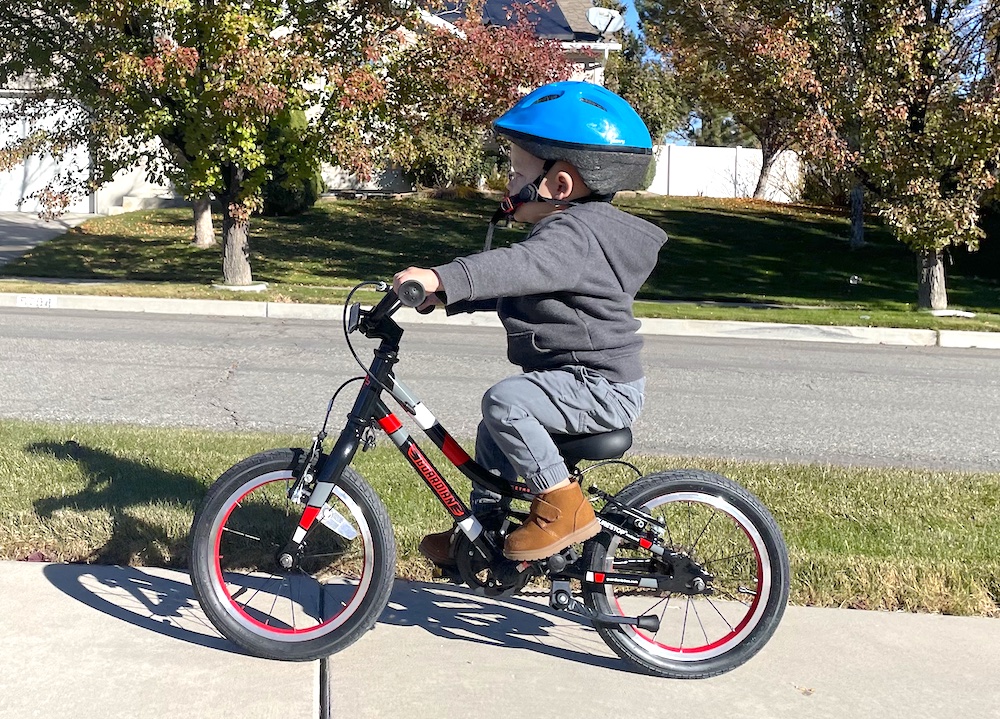
Although Guardian’s suggested minimum height for the Guardian 14 is 37″, our tiny 2.5 year old 33.5″ tester wanted to give it a go! Coming in at just 26 lb. and still wearing 18-month pants, he was on very high tiptoes with the seat at its lowest (16″).

Without the ability to reach the ground fully, he really should have been sticking to his balance bike, but he was determined. With the Guardian 14 being a bit too high for him, he first started on the smaller, now-discontinued Cleary Gecko, where he quickly mastered the art of pedaling. From there he was ready to move onto the larger Guardian 14, even though it was still technically too big for him.
After a couple of laps on the sidewalk, he was able to maneuver around turns and ride up the driveway, but because he could barely touch the ground, he couldn’t start from a stop on his own. He always needed a push from an adult.

After a couple of laps on the sidewalk, he was able to maneuver the bike around turns and ride up the driveway, but because he could barely touch the ground, he was unable to start the bike from a stop on his own. To start, he always needed a push from an adult since he could only touch the ground with his tip toes.
As a result, even though our tiny tester could ride the Guardian 14, it’s ideal for a beginning pedal bike rider to be able to touch the ground flat-footed when seated on the saddle. This lets them push off to start and use their feet to help stop when needed. So if a child’s inseam isn’t at least 16″, we highly recommend keeping them on a balance bike a little longer.

38.5″ Tall Testers
Our 3-year-old petite boy tester was learning to ride a pedal bike for the first time on the Guardian 14. Weighing 31 lbs., he struggled, became discouraged, and went back to his balance bike.
A few weeks later we were able to get him on the Prevelo Alpha One, which weighs almost 3 pounds less. His experience was a stark contrast. He took off pedaling and became a super confident rider within an hour.
Looking at the numbers: the Guardian is 51% of this rider’s body weight, while the Prevelo comes in at 43%. That difference is real and noticeable for smaller, less confident riders.
To be clear, this isn’t a knock on the Guardian, just a reference point to help you set expectations based on your budget. If you’re not up for spending $400+ on a kids’ bike but have a very petite child, it may be better to keep them on a balance bike a bit longer.
What size child fits on the Guardian 14?
As shown above, both our 33.5″ and 39″ testers were able to ride the Guardian 14, but only the taller 39″ toddler could start, stop, and maneuver the bike independently. The best way to determine fit is by inseam.
When a child is first learning to pedal, set the seat so they can touch the ground flat-footed when seated. At the bike’s lowest seat height of 16″, that means a child needs at least a 16″ inseam.

Flat-footed contact lets them use their feet to help stop and prevents falls when coming to a halt. It also makes learning to start from a standstill much easier, since they can paddle with their feet to build initial momentum.
As a child gains confidence, raise the seat so they can only touch the ground with their tiptoes. This allows for better leg extension and more efficient pedaling. How quickly you raise the seat depends on the rider. Our confident testers were ready for a raise after just a few days, while other kids may take weeks or months.
With a seat height range of 16″ to 21″ for comfortable riding, the Guardian 14 gives kids room to grow. For comparison, the similarly-sized woom GO 2 has a range of 15.5″ to 19.3″, the Prevelo Alpha One ranges from 14.8″ to 19.75″, and the Biky Air 14 goes from 17″ to 22″+.
How long will my child fit on this bike?
One year and two months after originally writing this review, we put our little girl tester back on the Guardian 14. She’s now 4 years old and 43″ tall with a 19″ inseam with shoes on, right at Guardian’s recommended maximum ideal height.
With the seat at its maximum comfortable height of 20.25″ and the handlebars raised to their max, she’s still a decent fit but clearly at the limits of the bike. As a comparison, during the same week we put her on the Guardian 20 Small with the seat at its minimum height of 21.3″.

Guardian sized these bikes so that transitioning directly from the 14 to the 20 Small is possible if you want to skip the 16. That said, skipping a size comes at a cost in performance and experience. Our tester also rode the 16″ during the same period, and the gradual size progression made for a noticeably more enjoyable riding journey.
Worth noting: the Guardian 14’s crank arms are 15 to 20mm shorter than those on other brands. This makes the bike more challenging to pedal efficiently for taller riders, since they have to spin their legs very quickly to gain speed. Our more experienced riders found this frustrating. The Biky Air 14 has longer cranks that address this, but it’s also significantly more expensive.
Guardian 14 Inch Bike Components
Guardian’s Fun Color Schemes
Guardian bikes are well known for their fun color schemes, and the Guardian 14 is no exception. It’s offered in six colors, all with a fun pop of color on the rims, plus optional color-coordinated accessories like handlebar grips and bells.

SureStop Braking System – How it Works
Guardian’s SureStop braking system brings hand brakes to little bikes (which we love) while also simplifying them. The system ties the rear brake to the front brake, so kids get the stopping power of dual hand brakes by pulling just one lever.

Here’s why that matters: on a standard dual-hand-brake bike, it’s important to teach kids to use either their right hand only (rear brake) or both brakes together, never just the left (front brake) alone.
If a child were to grab only the front brake, there’s a small risk of the front wheel stopping abruptly and pitching them forward. The risk is very rare on small, slow-moving bikes, but it’s real. Guardian’s system removes the possibility entirely by preventing the front brake from activating without the rear engaging first.

And have you ever tried to teach a toddler the difference between right and left? “Only brake with your right hand!” is a nearly impossible concept for little ones. With a single lever, there’s only one option, which is genuinely useful for young riders.
A note worth understanding before you buy: because the front and rear brakes are linked through a single lever and rear caliper, if the rear brake were to fail, the front brake cannot be activated. We’ve seen it happen twice in our testing: once when a crash bent the brake lever, and once when a cable wrapped around the head tube causing the rear brake noodle holder to stretch out. Both were rare and repairable, but it’s worth knowing. Do regular safety checks on your child’s bike, and be aware of how this system differs from two fully independent brake setups.
No Coaster Brake!
While most 12″ and 14″ bikes come standard with a coaster (back-pedal) brake, the Guardian does NOT have one. This is a huge win for the littlest riders just learning to pedal.
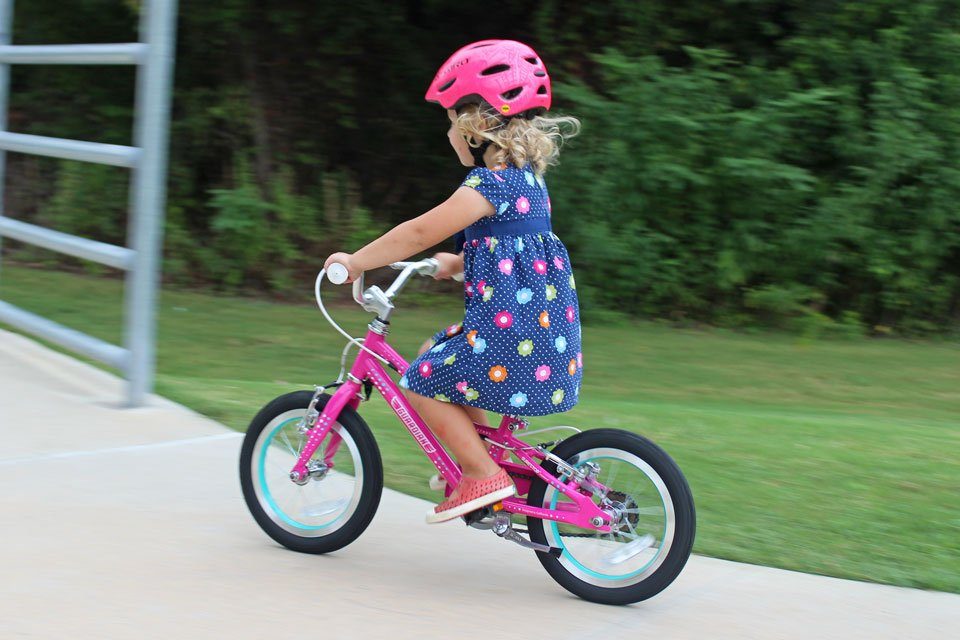
When kids are learning to pedal for the first time, they tend to pedal backwards a lot. If they’ve just gotten started, gained a little momentum, and then back-pedal, a coaster brake stops them cold. All momentum lost.
Being able to pedal backwards works with a child’s natural tendencies and makes the process of learning to pedal significantly easier, especially for young riders on 14″ bikes. It also helps kids regain balance when they turn too sharply or start leaning. If they instinctively pedal backward to steady themselves and the bike stops instead, they often crash.

And let’s not forget how hard it is to get pedals positioned to start pedaling in the first place. If you can’t move them in both directions, getting them set to go can feel nearly impossible for little hands.
Body Position and Geometry
All Guardians are known for their kid-friendly geometry, and the Guardian 14 is no exception. The mid-rise handlebars place a child in a comfortable, upright position, natural and relaxed as they’re learning to ride.
The Guardian 14 also places a child close to the ground, which lowers their center of gravity and makes balancing easier. It allows a younger or shorter child to confidently ride a 14″ bike without training wheels.

If you’ve ever seen a child perched awkwardly on top of a big-box-store bike, you’ll know why kid-friendly geometry matters. Our almost-3-year-old tester can comfortably touch the ground with her tiptoes on the Guardian 14 with its seat post raised about 2″. She can’t even reach the ground on the 14″ RoyalBaby (20 lbs., by the way!) with the seat all the way down.

Big-box-store bikes also tend to have small cockpits that leave kids feeling cramped with limited room to maneuver. The Guardian 14’s extended wheelbase offers ample room to move and grow into.
Weight
At 16 lbs. (with pedals and kickstand), the Guardian 14 is lighter than the bikes you’ll find at a big-box store. For a steel-frame bike at this price, that’s a solid result.
That said, it isn’t as light as boutique-brand bikes like the woom GO 2 or the Prevelo Alpha One, both of which use aluminum frames and come in several pounds lighter at a higher price. If weight is your top priority, those bikes are worth the added investment.
We’re big advocates of lightweight bikes for kids, but shaving pounds always costs more. The 16 lb. Guardian 14 is light enough for the vast majority of kids out there, and the tradeoff between weight and price is a reasonable one for many families.
Super Short Crank Arms
The Guardian 14’s crank arms are shorter than those on other 14″ bikes we recommend. Guardian’s cranks are 70mm, while woom’s are 80mm and Prevelo’s are 85mm. While 10 to 15mm doesn’t sound like much, it leads to a smaller pedal revolution, which can be frustrating for faster or more aggressive riders.

Our more aggressive 3-year-old tester did have his feet fly off the pedals a couple of times when trying to pedal quickly. And as kids get taller, completing those small pedal revolutions becomes increasingly awkward. So while the bike may technically fit for a while, the pedaling efficiency declines before the fit does.
If you expect your little one to be a really aggressive rider, but higher-end bikes aren’t in your budget, we recommend waiting a bit longer until your child can fit onto a 16” bike where short crank arms aren’t as much of an issue.
Gain Ratio
With a gain ratio of 3.95, the Guardian 14 requires just slightly more pedaling effort than some alternatives. The woom GO 2 is 4.0 and the Prevelo Alpha One is 3.77. Higher gain ratios make it harder to get started but enable faster top speeds; lower ratios make starting easier but cap speed.

Because of the overall size of 14″ bikes and their component limitations, all high-quality bikes in this size tend to have relatively low gain ratios. That’s actually a benefit, since it makes getting started easier for new pedalers. Our youngest testers had no issue with the 3.95 ratio. The real limitation isn’t the gearing; it’s the short crank arms, which become the bottleneck for taller, more aggressive riders as they approach the top of the size range.
Just be sure to set realistic expectations around distance and speed. Kids on 14″ bikes simply can’t cover as much ground per pedal stroke as they will on a larger bike. That’s fine when they’re learning, but as they get more confident and want to go faster and farther, it will become a source of frustration and a sign it’s time to size up.
Turning Limiter

The Guardian 14’s turning limiter is mild and easily removable. Use it if you want to, or take it off. Its main practical purpose is preventing the handlebars from rotating all the way around when a child falls or puts the bike down, which keeps the brake cables from getting stretched and prevents little ones from getting confused trying to sort out twisted bars. We like having the option.
Kickstand

The Guardian 14 comes standard with a kickstand. One small quirk: the pedals can occasionally get jammed against the kickstand, making it hard to kick up. In practice, most young kids won’t be managing the kickstand independently anyway, so it’s a minor issue.
Easy Assembly
When you open the box, you’ll find the bike mostly assembled, with both wheels already attached. All that’s left is tightening the seat post collar, attaching the pedals, and installing the handlebar. Guardian includes alignment etches on the bars and stem to make handlebar positioning foolproof.

Training Wheels
While we’ll always advocate for a balance bike over training wheels, if you’re going the training wheels route, Guardian does offer a compatible set for their 14″ bike.
Guardian vs. Other Brands
The Guardian 14 is a fabulous little bike for young riders at a mid-range price point. If you are looking to spend a little less or a little more, here are some other options. The Guardian 14, however, is the least expensive 14″ bike that we know of that doesn’t have a coaster brake.
| Bike | MSRP | Seat Height | Weight |
|---|---|---|---|
| Retrospec Koda | $149 | 15.5″ – 18.5″ | 17 lb. |
| Retrospec Koda Plus | $219 | 15.8″ – 19″ | 15 lb. |
| Guardian 14 | $249 | 16″ – 21″ | 16 lb. |
| Biky Air 14 | $449 | 17″ – 22″ | 11.95 |
| woom GO 2 | $459 | 15.5″ – 19.3″ | 12.3 |
Guardian 14 Bike Review Bottom Line
The Guardian 14″ is a genuinely solid first pedal bike for most kids. With kid-friendly geometry, no coaster brake, and a simplified braking system, it’s a bike that works with young riders rather than against them.
At $269, it sits at a mid-range price point, a meaningful step up from big-box store bikes and worth it. Just know that higher-end options like the woom GO 2, Prevelo Alpha One, and Biky Air 14 use aluminum frames and offer lighter weight and longer crank arms at a higher price. For families where weight is a priority, those are worth comparing.
If your child is small and barely able to fit on the Guardian 14 pedal bike, we highly recommend starting with the Guardian balance bike first and letting them work up to it.
FTC Disclosure: Affiliate links are included in this review. No monetary compensation was provided for this review, however, the reviewed product was supplied by the manufacturer or distributor to help facilitate this review. All opinions and images are that of Two Wheeling Tots LLC. All content and images are copyrighted and should not be used or replicated in any way. View our Terms of Use.
