

The Best Kids Bikes for All Ages: Top Brands Tested and Reviewed
The best kids’ bikes rarely come from the big brands you know. After testing over 300 kids’ bikes in the last 15 years, we’ve found that online, kid-specific bike manufacturers are often your best bet for high performance and safety.
These brands don’t treat kids’ bikes as an afterthought. Instead, they specialize in designs that far exceed safety standards and make bikes that are lighter, easier to ride, and far more enjoyable for kids. We’ve seen countless kids struggle on cheap, heavy, big-box store bikes, only to hop on one of these bikes and pedal away with confidence.
| Brand | Standout Feature | Price |
| Best for Everyday Riders | ||
| Retrospec Koda | Best Budget | $ |
| Priority Bicycles | Easiest to Maintain | $$ |
| Biky Bikes | Best Extended Fit | $$$$ |
| woom Bikes | Best Overall | $$$$ |
| Best for Adventurous Riders | ||
| REI Co-op REV | Best Value (20”, 24” only) | $$$ |
| Prevelo | Best Overall | $$$$ |
| Early Rider | Exceptional Quality | $$$$ |
For additional details on each of these brands, jump down to our Best Kids Bike Brands below. For additional recommendations available outside the US, see our international recommendations below.
What Makes a Kids Bike Great?
So, what makes these bikes so much easier and more fun to ride? Why do they outperform familiar brands like Huffy, RoyalBaby, or Kent? The difference lies in the details. After years of testing hundreds of kids’ bikes, we can confidently say the best bikes are easier to ride than the average kids’ bikes for the following reasons:


For a more in-depth look at what to consider when buying a kids’ bike, check out our detailed guide: The Hidden Costs of Cheap Kids’ Bikes.
BEST BIKES FOR EVERYDAY RIDERS
These brands are ideal for everything from cruising around the neighborhood, riding to school or even longer rides with the family. The brands we showcase on this page truly deliver the best kids pedal bikes on the market. If you have a child 18-months to 3 years old, be sure to check out our best balance bikes article.
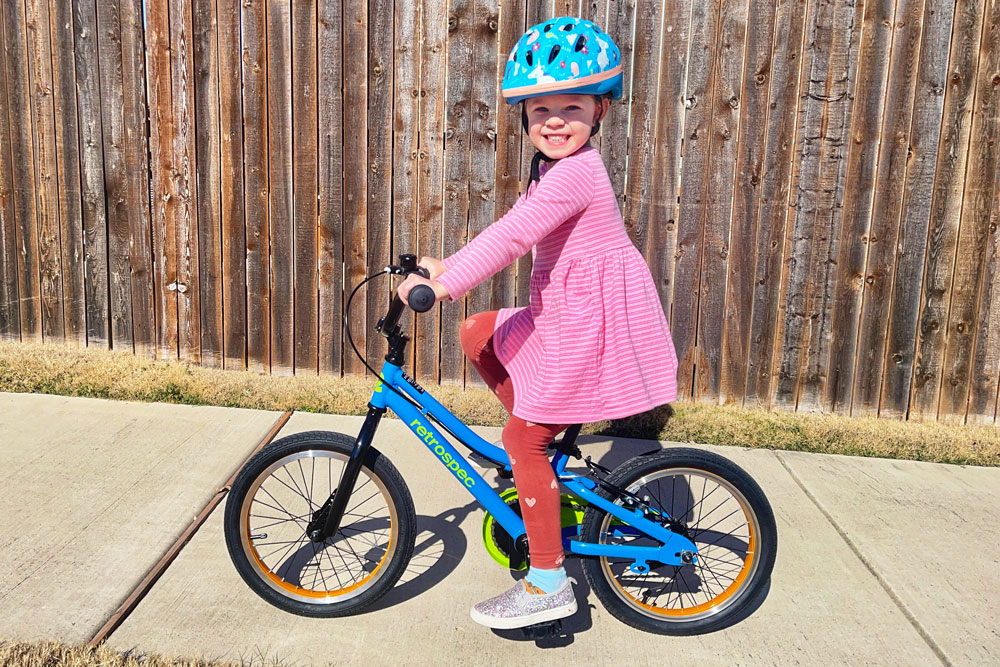
Retrospec Koda and Koda Plus
$149 – $279
SIZES: 12″ to 20″
BRAKES: Varies by size and model, all have at least one hand brake
TRAINING WHEELS: Come standard on 12″ and 16″
Why We Love the Retrospec Koda and Koda Plus
We’ve tested many budget-friendly kids’ bikes over the years, and the Retrospec Koda and Koda Plus stand out for their smart geometry, lighter weight, and kid-focused design. Compared to big-box store bikes, both models are easier to ride, more comfortable, and built with better components.
Both models are available in 12”, 16” and 20” in single speeds (check out their Dart line for geared 20” and 24” models) . The Koda is a great entry-level bike for paved neighborhood riding, with a steel frame and a simpler setup. The Koda Plus, steps things up with a lightweight aluminum frame, dual hand brakes, and upgraded metal levers with tool-free reach adjusters—ideal for more confident or experienced riders.
Both the 12″ and 16″ models come with training wheels and are compatible with them if needed, though we always recommend starting with a balance bike for the best learning experience.
Note: We don’t recommend the 12” Koda (or any 12” pedal bike in this price range) as a first bike. With small crank arms and coaster brakes, they can be difficult to ride and stop. If your budget is tight, a balance bike is a much better place to start.
Priority Bicycles
$329 – $499
SIZES: 14” to 26″
BRAKES: Dual hand brakes
TRAINING WHEELS: Compatible on 16″
Why We Love Priority Bikes
Priority Bicycles are a standout option for families who want a high-quality bike that’s not only sleek and modern—but also low-maintenance and easy to use.
What sets Priority apart are three key features: a grease-free carbon belt drive, internally geared hubs (on 20” and 24” models), and lightweight aluminum frames with clean, classic styling. The carbon belt drive replaces the traditional chain, eliminating greasy hands, dropped chains, and regular upkeep—while lasting significantly longer.
On their geared bikes, the internally geared hubs provide smooth, simple shifting with minimal maintenance. Unlike traditional derailleurs, which are prone to getting bumped or knocked out of alignment, internal hubs are sealed and protected—perfect for active kids who may not always treat their bikes gently.
If you’re looking for a premium ride that minimizes the headaches of traditional bike maintenance, Priority is hard to beat.

woom Bikes
$459 – $869
SIZES: 14” to 26″
BRAKES: Dual hand brakes (14” and 16”), Hydraulic Disc Brakes (20”+)
TRAINING WHEELS: Not compatible
Why We Love woom Bikes
Easy, intuitive, and incredibly lightweight, woom bikes are designed to make riding feel as natural and confidence-building as possible. Every component from the grips to the tires is purpose-built for young riders, ensuring the best possible fit, control, and efficiency.
For beginning riders, woom’s GO Series (available in 14” to 20” models) is the perfect introduction to two wheels. With a low step-through frame, upright geometry, and lightweight build, the GO helps new or timid riders feel comfortable and helps build confidence. It’s ideal for everything from fun neighborhood rides to extended rides along bike paths.
As kids grow and start to explore beyond the neighborhood, the woom EXPLORE Series (available in 20” to 26”) takes them to the next level. Built for older and more adventurous riders, the EXPLORE combines woom’s famously lightweight frame with a wider gear range, hydraulic disc brakes, and an adjustable headset that extends the bike’s fit range.

Biky Bicycles
$399 – $499
SIZES: 14” to 20″
BRAKES: Dual hand brakes
TRAINING WHEELS: Not Compatible
Why We Love Biky Bicycles
Biky Bicyles are designed to make riding easier and more enjoyable for young riders, offering an impressively lightweight, comfortable, and efficient experience. Prioritizing kids’ comfort, these bikes feature a thickly padded saddle, a narrow q-factor, a semi-upright riding position, and smooth-rolling tires for an easy ride on paved surfaces.
One standout feature of Biky is their slightly extended seat height range, helping delay the need for a size upgrade as kids grow. Additionally, their longer crank arms mean kids don’t need to pedal as fast as other bikes to reach higher speeds. Their narrow q-factors and rear hubs further streamline each pedal stroke, allowing kids to pedal without splaying their legs for a more natural, efficient motion.
Another unique aspect is Biky’s 20″ bike, which is available exclusively as a single-speed. Since many young riders who fit on 20″ bikes don’t need gears, the Biky 20″ delivers a fun, fast, and simple riding experience that our testers truly enjoyed. Plus, without the extra weight of gearing, the Biky 20 is about 5 pounds lighter than many of its geared competitors, making it easier for kids to handle.
BIKES FOR ADVENTUROUS RIDERS
If your little rider is chomping at the bit to go off the beaten (or paved), these brands are the perfect for adventurous riders.

REI Co-op REV
$459 – $559
SIZES: 20” to 24″
BRAKES: Mechanical disc
TRAINING WHEELS: Not Compatible
What We Love about REI Co-op REV
REI Co-op REV bikes strike a great balance between performance, price, and convenience. While they’re heavier than higher-end brands like Prevelo or Early Rider, they’re also more affordable and backed by REI’s solid return policy and warranty. The bikes can also be picked up fully assembled at your local store.
REV bikes come equipped with mechanical disc brakes for reliable stopping power and wider tires that add extra cushioning and stability on mixed terrain. They’re not built for highly technical trail riding, but they perform great on basic dirt trails, bike paths, and around-town adventures.
The gear range isn’t as wide as what you’ll find on more performance-oriented brands, but for everyday family rides and light trail use, REI Co-op REV bikes deliver solid value and dependable performance.

Prevelo Bikes
$489 – $859
SIZES: 14” to 26″
BRAKES: Dual hand brakes (14” and 16”), Hydraulic Disc Brakes (20”+)
TRAINING WHEELS: Not Compatible
Why We Love Prevelo Bikes
If you have a confident and adventurous rider on your hands, Prevelo Bikes should be at the top of your list. Designed with lightweight, low, and narrow frames that precisely fit young riders, Prevelo bikes are quick, responsive, and built to inspire confidence helping kids push their skills to the next level.
The updated Alpha Series now features even lighter frames, internally routed cables, and a cleaner overall design. Every bike still comes equipped with all-terrain tires, making it easy for kids to transition from neighborhood rides to dirt trails and back again. For families who hit the trails often, the standard 1.75″ tires can be upgraded to wider 2.1″ tires for added traction and stability.
Starting with the 20″ Alpha Three, riders get trigger shifters that provide fast, intuitive gear changes ideal for kids ready to tackle bigger hills or move toward mountain biking. The latest Alphas also feature upgraded gear ranges for easier climbing and more speed on straightaways, along with powerful hydraulic disc brakes (on 20” and up) for consistent stopping power in all conditions.
Prevelo’s thoughtful design and top-tier components make their bikes some of the most capable and confidence-boosting rides available for kids built to handle years of adventures and growth.

Early Rider
$514 – $1,099
SIZES: 14” to 24″
BRAKES: Dual hand brakes
TRAINING WHEELS: Not Compatible
Why We Love Early Rider Bikes
Early Rider bikes are the definition of craftsmanship and performance. From the smoothness of their bearings to the custom built pedal, every component is well thought out and refined. These bikes aren’t just built to last, they’re works of art on two wheels.
Each model features a beautifully polished aluminum frame that’s as durable as it is stunning, with select models available in color-finished versions. Beyond their beauty, Early Rider bikes deliver true high-performance ride quality that kids can feel from the very first pedal stroke.
Early Rider’s lineup is divided into three distinct series to match your rider’s style:
- Urban Series: Lightweight, fast, and efficient, ideal for city streets, paved paths, and everyday cruising.
- Trail Series: Built for off-pavement fun, with geometry and tires tuned for confident handling on dirt and gravel.
- Performance Series: Designed for serious young riders with suspension forks and premium components for tackling aggressive terrain and all-day trail adventures.
Whether your child is rolling to school, exploring local trails, or chasing singletrack, Early Rider bikes combine top-notch build quality with real-world performance into one beautiful package.
International Kids Bike Brands (Outside the US)
While our main guides focus on brands available in the U.S., we know many of our readers live in Canada, Europe, or Australia. Fortunately, there are several outstanding kids’ bike brands in these regions known for their performance, safety, and thoughtful design. While we’ve tested a few of these brands, we’re not as familiar with them overall and can’t speak to specific models in detail.
Canada
Forth Bikes – Mountain bikes and all-terrain bikes 14” to 24”.
Spawn Cycles – Everything from balance bike to full suspension MTBs.
Australia
base bikes – Balance bikes to 20” all-terrain bikes
Frog Bikes – The widest variety of quality kids bikes, balance bike to road bike and mountain bikes!
Europe
Check out Cycle Sprog for the kids bike recommendations in Europe.
What to Look for in a Kids Bike
Why are these kid-focused bike brands so good and why are Walmart bikes just so bad? Here are seven key features, and a deeper dive into each.
- Weight
- Frame Geometry
- Brakes
- Gearing and Shifting
- Ease of Assembly
- Exceptional Customer Service
- High resale value
Lightweight Bikes Are Easier to Ride
Most adults ride bikes that are about 20% of their total weight, while kids’ bikes are usually around 50% of a child’s weight! Ideally, a child’s bike should be less than 40% of their weight. While all kids benefit from lightweight bikes, a few pounds makes an even bigger difference for young, timid, or beginning riders.

While all the brands on this page build bikes that are much lighter than the average bike, woom bikes is king when it comes to lightweight kids bikes. For example, the 16″ woom 3 bike weighs only 13.1 pounds while the RoyalBaby 16″ bike weighs 22.3 pounds. For a 40 lb. child, the woom 3 is 33% of the child’s weight while the RoyalBaby is 56%!
Weight, however, should never be looked at in isolation. Some cheap big-box-store bikes are similar in weight to higher-end bikes, but only because their wheelbases are narrower (they have a too-small frame) and they lack components such as hand brakes.
Kid-specific Bike Geometry
The design and shape of a bike’s frame goes way beyond looks. If a bike’s frame is poorly designed, it will be very hard for a child to ride.
Wheelbase and Cockpit Size
If you’ve ever had to drive a car sitting WAY too close to the steering wheel, you know that it greatly affects your ability to drive the car. From slower reaction times to inhibited maneuverability, you need space when driving!
Riding a bike is the same way. If the bike seat and the handlebars are too close (the cockpit), a bike will be significantly harder for a child to ride.

A major factor in creating an ample-sized cockpit is the bike’s wheelbase (the distance between the wheels’ axles). With kids bikes, a smaller wheelbase almost always means a smaller cockpit.
Take a look at the example below. The small child is riding a green budget bike on the left, vs. a purple Prevelo bike on the right. Although both of these bikes are meant to fit the same size child (the seat heights are set to the same height), the Prevelo has a much larger cockpit.
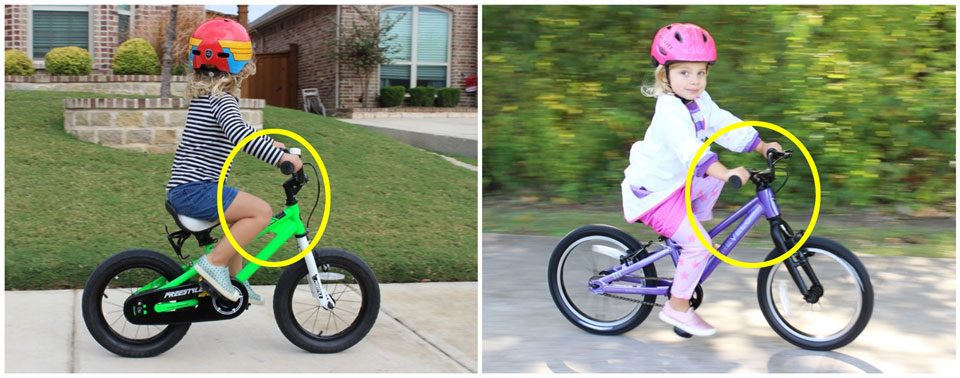
Notice that the distance between the child’s knees and the handlebars is much greater on the Prevelo. As a result, the rider feels much less cramped on the bike and it is easier for her to maneuver.
Q-factor
The q-factor of the bike is a measurement of the width between the pedals. Lower-end bikes are typically wider and require kids to splay out their legs in order to pedal. This splay in their pedaling greatly decreases the efficiency of each pedal stroke.

Bottom Bracket Height – Lower is Better
The bottom bracket of a bike is essentially where all the components that allow for pedaling (crankset, crank arms, etc.) attach to the frame of the bike. The distance between the bottom bracket and the ground plays a role in the bike’s overall center of gravity and in the efficiency of each pedal stoke.

Lower Center of Gravity Makes it Easier to Balance
If a bottom bracket is positioned high on a bike, the child will sit higher off the ground, creating a higher center-of-gravity. A higher center-of-gravity on a bike is much less stable at lower speeds. Since kids typically ride at lower speeds (they start and stop often), a bike with a lower center-of-gravity is much easier for them to balance.
Pedal Angles
Higher bottom brackets produce less efficient pedaling. The higher the bottom bracket, the less space there is between the child’s seat and the pedal at the top of the pedal stroke. As a result, the child will have to bend their knee at a greater angle on the pedal upswing, which places their legs in a much less efficient position once they hit the downswing.

Quality Handbrakes for More Stopping Power
The brakes on kids bikes range vastly in quality and performance. The brakes on higher-end bikes stop faster and with much less effort required by the child. Being able to stop your bike quickly and consistently affects both the safety and confidence of your child.
Hand brakes vs. coaster brakes
Hand brakes on a child’s bike are always preferred over coaster brakes (back-pedal brakes). Unfortunately, the vast majority of kids bikes on the market come with coaster brakes. Why? They are very cheap and don’t add a lot of money to the production costs of the bike.
Quality hand brakes add significant costs to a bike. With more parts and even more time required to install and tune the brakes, reliable handbrakes are simply not available on low-cost bikes.

So what’s wrong with coaster brakes? Coaster brakes are particularly tricky for young kids as they prevent them from naturally pedaling backward. Upon doing so, the bike unexpectedly stops, which often results in a fall. This can make learning to pedal much more difficult.
Coaster brakes also prevent kids from properly lining up their pedals to “go position” which makes it more difficult to start pedaling from a stop.
Quality vs. Budget Hand Brakes
A quality hand brake is easy for a child’s hand to reach and requires minimal effort to pull without loosening their grip on the handlebar. The easier a brake is to engage, the more likely a child will use it!

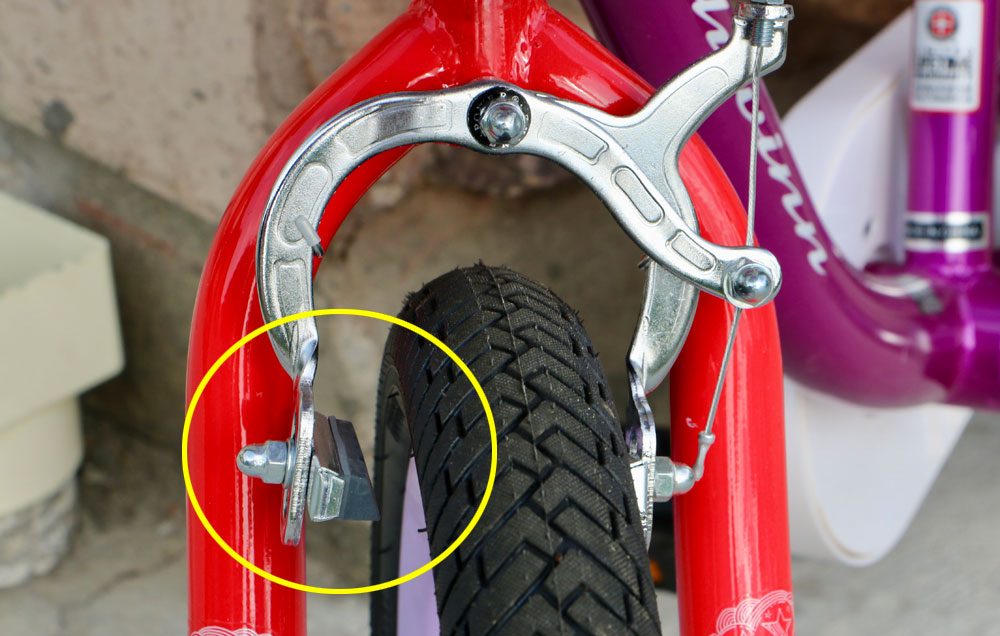
While some cheap kids bikes have hand brakes, they are typically hard to reach and very unreliable. Often built with single-pivot calipers, budget hand brakes are almost impossible to properly adjust and should not be expected to stop a bike.
Don’t assume that a cheap bike is better because it has a hand brake. It’s usually not. Also don’t assume that because the hand brake passed CPSC certification that it’s going to work well.
Gearing and Shifting
How High or Low is the Bike Geared?
How high or low a bike is geared will determine how easily a child can climb up a hill or pedal quickly to keep up on a flat path. When referring to the gears on a bike, we compare bikes based on the gain ratio of the bike’s gears.
A high gain ratio requires more effort to get started but allows the bike to travel farther with every pedal stroke.
A low gain ratio requires less effort to get the bike started but requires more “pedal spinning” to get the bike going.
Single Speed Bikes: A 16″ bike with a gain ratio of 3.2 is going to to take much less effort for a child to start pedaling than a 16″ with a gain ratio of 4.0. However, the top speed of the 3.2 bike is going to be much slower than the bike with the 4.0 gain ratio.
Geared Bikes: It’s important to look at the ranges of the gain ratio. A 7-speed bike with a gain ratio range (the spread between the lowest and the highest gear) of 2.2 to 4.45 offers a much more narrow gear range than a 7-speed bike with a 2.2 to 6.7 gain ratio range.
Drivetrain

If your child is on a 20″ bike or larger and needs gears, versus wants them, purchasing a bike with a quality drivetrain will make a huge difference in their ability and desire to use their gears. Higher-end bikes typically have more robust drivetrain systems that can better handle the wear and tear from kids, and allow for smoother shifting. With a cheaper drivetrain, shifting will feel more clunky and awkward.
Grip Shifters vs. Triggers Shifters
The type of shifters on a bike can make shifting a breeze or a challenge for young riders. The shifters on higher-end bikes are typically significantly easier for a child to use and wear better with time.
There are two main types of shifters – grip shifters and trigger shifters. Grip shifters are common on kids bikes as they are the most intuitive to use. To shift, kids simply twist forward or back on the grip. For more advanced or aggressive riders, grip shifters aren’t ideal as they don’t allow kids to shift as quickly.
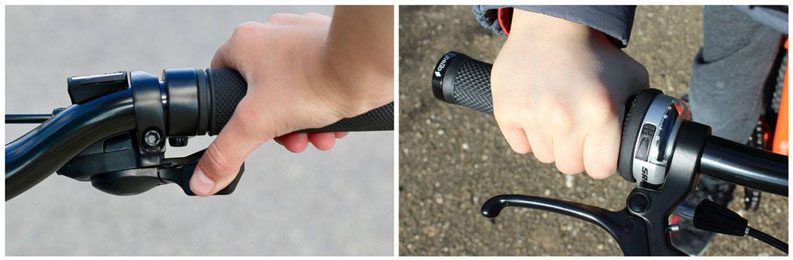
Trigger shifters offer faster (and often smoother) shifting, but they can be more confusing for kids to learn. Instead of twisting with their hands, trigger shifters require kids to push or pull a lever with their fingers.
Easy to Assemble!
Assembling a bike can be very complicated, but for the best kids bikes, brands have made an art out of simplifying the process. From clear and concise instructions to included tools, most of the high-end bike brands can be assembled in about 10 – 15 minutes!
Quality Customer Service
Passionate about bikes and their products, one of the major benefits of purchasing from a kid-specific bike brand is the customer service they provide. Whether something isn’t quite right with your bike or you are confused about assembling it, their customer service is exceptional.
High Resale Value
Quality kids bikes aren’t cheap, but they are a great investment. As long as they are properly maintained and cared for, each of these brands have a high resale value, so you can expect to get at least half (but likely much more) of your investment back once your child outgrows it.
Our Favorite Kids Bikes by Size
Looking for more details on bikes of specific sizes? Check out our list of favorites for kids of every age.
- 12 and 14 Inch Bikes: Bikes for 3+ (or really advanced 2-Year-Olds!)
- 16 Inch Bikes: Bikes for 4+
- 20 Inch Bikes: Bikes for 5+
- 24 Inch Bikes: Bikes for 7+
- 26 and 27.5 Inch Bikes: Best for 10+
