Trek Precaliber 12 Kids Bike Review
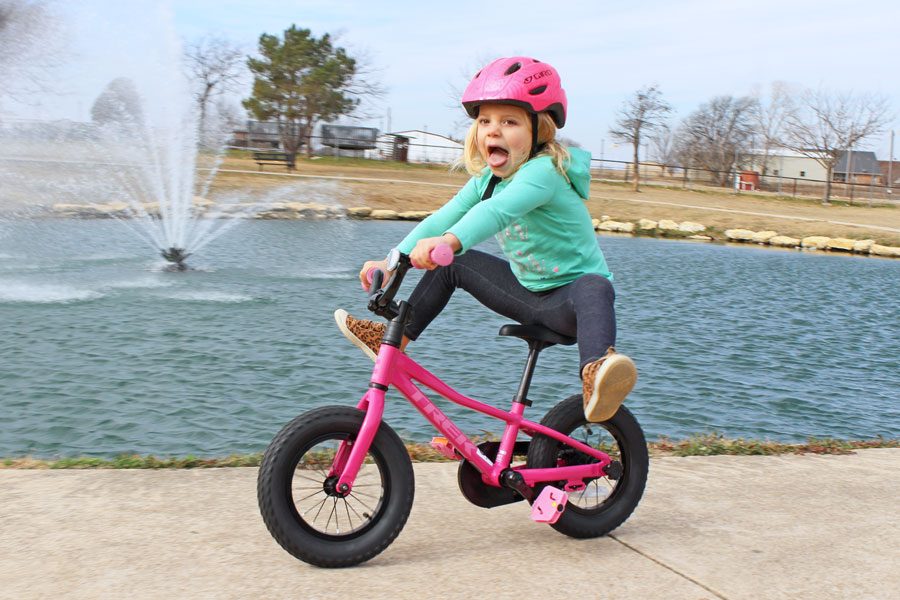
The Trek Precaliber 12 is a solid little lightweight aluminum bike that is extremely durable with great geometry, but it falls short compared to other 12″ and 14″ bikes on the market. With no hand brakes and only a coaster brake, it lacks the quality and performance that we would expect in its price range. While the bike is absolutely rideable and our testers thoroughly enjoyed it, for its price range, we would consider looking at some other options.
If you plan on using training wheels with your little one, however, the Trek Precaliber 12 is a great option. It’s stable, easy to use, and comes with tool-free training wheels that are among the best we’ve tested. The combination of Trek’s quality construction and thoughtful training wheel design makes this bike ideal for that specific use case—just know that it won’t grow with your child into hand-brake territory the way similarly-priced competitors will.
**CPSC RECALL** Some 2024 and 2026 Precaliber 12 bikes have been recalled due to a coaster brake issue. Not all bikes, however, are affected by the issue. Check out Trek’s recall notice for more specific information.
Trek Precaliber 12
OUR SCORE: 54.1/100 – Recommended for Training Wheels Users
MSRP: $299
BEST FOR: Kids in size 2T to 4T pants
SEAT HEIGHT: 15.25″ – 18.75″
WEIGHT: 14.3 lb.
ADDITIONAL SPECIFICATIONS
BRAKES: Coaster Only
FRAME: Aluminum
GAIN RATIO: 3.95
TRAINING WHEELS: Tool-free training wheels included
Cons:
Our 12 and 14″ Bike Rubric Score
The Trek Precaliber 12 is a well-built, lightweight aluminum bike with excellent geometry that’s perfect for young riders—if they’re using training wheels. With a rubric score of 51.4 out of 103, the Precaliber falls into the middle-to-lower range of 12″/14″ bikes we’ve tested. While it excels in frame design, weight, and customer support, the lack of any hand brakes (scoring 0/20 in our brakes category) significantly limits its versatility and learning potential for balance bike graduates.
If you plan on using training wheels with your little one (though we’d highly recommend a balance bike instead), the Trek Precaliber 12 is actually a great option, it’s stable, easy to use, and comes with tool-free training wheels that are among the best we’ve tested. However, for the $299 price point, we’d love to see Trek add at least one hand brake to make this bike more competitive with other options on the market. See all 12″/14″ bike scores.
How the Trek Precaliber 12 Scored
Score Breakdown ▼
Weight 9.9 / 20 ▼
How it’s scored: Weight score is calculated proportionally, with the lightest bike in the comparison set receiving 20 points and the heaviest receiving 0 points.
Bike Weight: 15.08 lbs
Frame Design 18 / 20 ▼
What we evaluate: Evaluates the bike’s structural foundation and geometry. Points are awarded for features that reduce weight, lower the center of gravity, improve stability, and make the bike easier for young riders to mount and control.
- ✅ Aluminum Frame (4 pts)
- ✅ Low Bottom Bracket (3 pts)
- ✅ Low Min Seat Height < 17" (3 pts)
- ✅ Confidence Building Geometry (3 pts)
- ✅ Low Step-Through Frame (3 pts)
- ❌ 14″ Wheels vs 12″ Wheels (2 pts)
- ✅ Threaded Bottom Bracket (2 pts)
Components 13 / 20 ▼
What we evaluate: Assesses the quality and appropriateness of parts that directly affect ride quality and durability. Gain ratio (3.5–4.0) and crank arm length (81-90mm = 4pts, 75-80mm = 3pts, 70-74mm = 2pts) are scored based on optimal ranges for 14″ bikes.
- ◐ Crank Arm Length 71mm — 2 of 4 pts (70-74mm range)
- ✅ Narrow Q-factor (3 pts)
- ❌ Gain Ratio 3.5-4.0 (2 pts)
- ✅ Quality Seat Post Quick Release (2 pts)
- ✅ Adjustable Handlebar (2 pts)
- ✅ Sealed/Cartridge Bottom Bracket (2 pts)
- ✅ Rattle-free Chain Guard (1 pt)
- ❌ Kickstand Included (1 pt)
- ✅ Grips with Protective Bumper End (1 pt)
- ✅ Schrader-Compatible Rim (1 pt)
- ✅ Comfortable Padded Saddle (1 pt)
Brakes 0 / 20 ▼
What we evaluate: Focuses on stopping power and safety. Prioritizes hand brakes over coaster brakes, rewards features that make brakes easier for small hands to operate, and values brake system redundancy.
- ❌ No Coaster Brake OR Removable Option (4 pts)
- ❌ Short Reach Brake Levers (4 pts)
- ❌ V-Brakes (4 pts)
- ❌ Easy Pull Levers (3 pts)
- ❌ Alloy Brake Levers (2 pts)
- ❌ Brake Duplicity (2 pts)
- ❌ Tool-Free Adjustable Reach Levers (1 pt)
Useable Fit Range 2.5 / 10 ▼
How it’s scored: Bikes with wider useable seat height ranges score higher on a proportional scale, where the widest range scores 10 points and the narrowest scores 0 points. Useable range is calculated as the lesser of (handlebar height – 2.5″) or max seat height, minus minimum seat height.
Useable Range: 2.0″
Ease of Assembly 3 / 6 ▼
What we evaluate: Measures how parent-friendly the out-of-box setup is. Points are given for clear instructions, minimal assembly requirements, and pre-tuned brakes.
- ✅ Clear Written Instructions (2 pts)
- ❌ Video Instructions (1 pt)
- ✅ Easy Assembly (1 pt)
- ❌ Pre-tuned Brakes (2 pts)
Customer Service 4 / 4 ▼
What we evaluate: Evaluates the manufacturer’s post-purchase support. Bikes earn points for responsive customer service, frame warranties, and component coverage.
- ✅ Customer Service with Real Person (2 pts)
- ✅ Frame Warranty (1 pt)
- ✅ Partial Component Warranty (1 pt)
Extra Credit +1 ▼
What earns extra credit: Bonus points for innovative features that enhance versatility or usability beyond standard expectations.
- ✅ Easily Converts to Balance Bike (+1 pt)
- ❌ Tool-Free Training Wheel Compatibility (+1 pt)
- ❌ Color Coded Levers/Cables (+1 pt)
- ❌ Rear Placed Kickstand (+1 pt)
Results of our Test Rides on the Precaliber 12
We purchased a Trek Precaliber 12 from our local bike shop. To put it to the test, we had three of our 3-year-old testers take it for a spin. Two of those riders were experienced pedal bike riders, while the other is just transitioning from a balance bike.
Frame Design – Much Better Than Most 12″ Bikes
If we’re being honest, most 12″ pedal bikes on the market are garbage. They are awkwardly sized so that the seats are too tall and the frames are too cramped for the small riders they are supposedly designed for. A side by side comparison to the super budget Huffy 12″ quickly demonstrates just how bad the frame design of most 12″ bikes are. Their frames are too short and are often paired with handlebars that are too high.
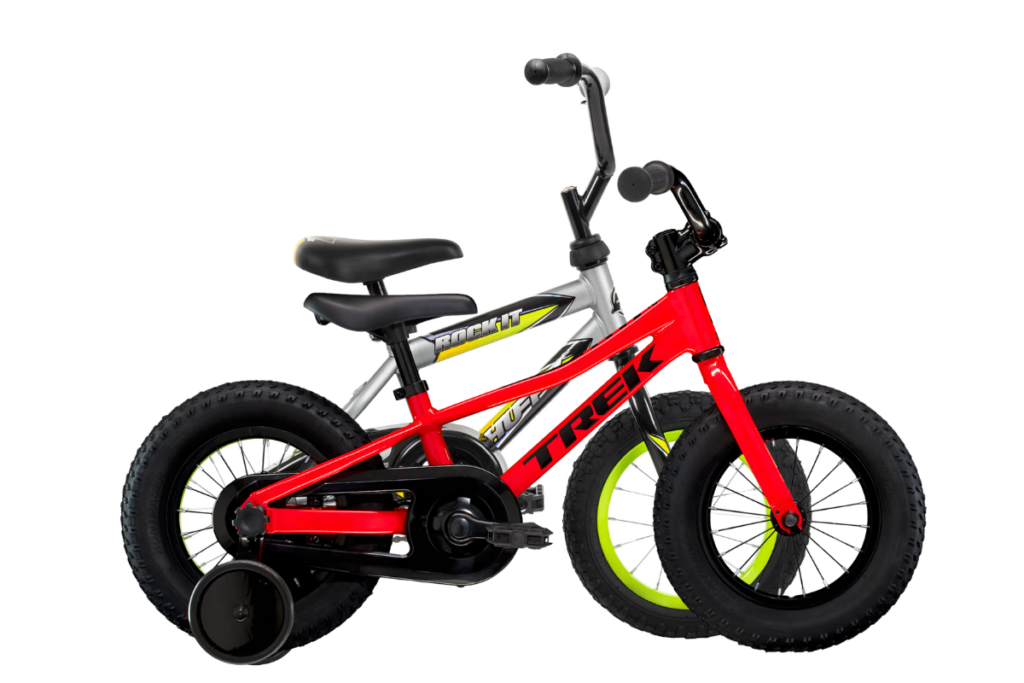
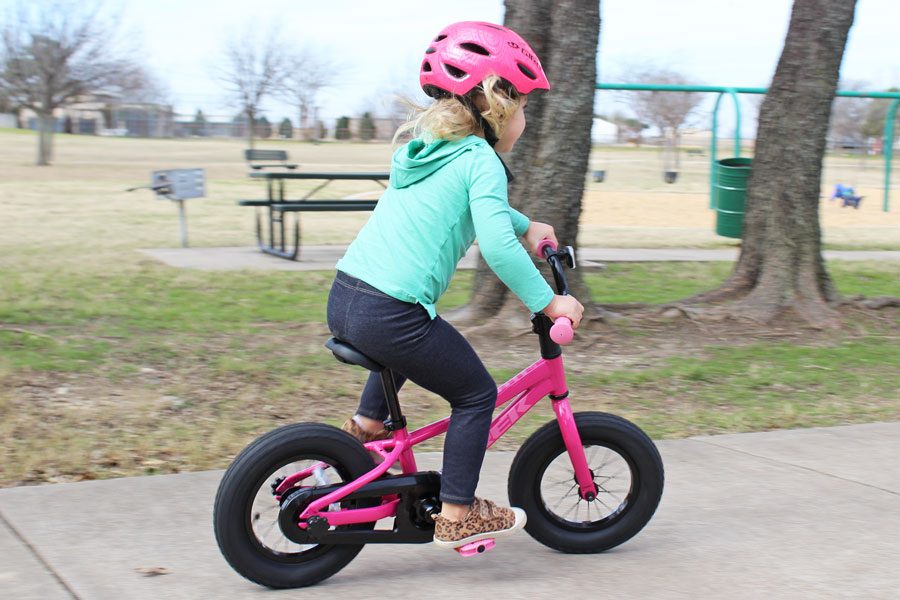
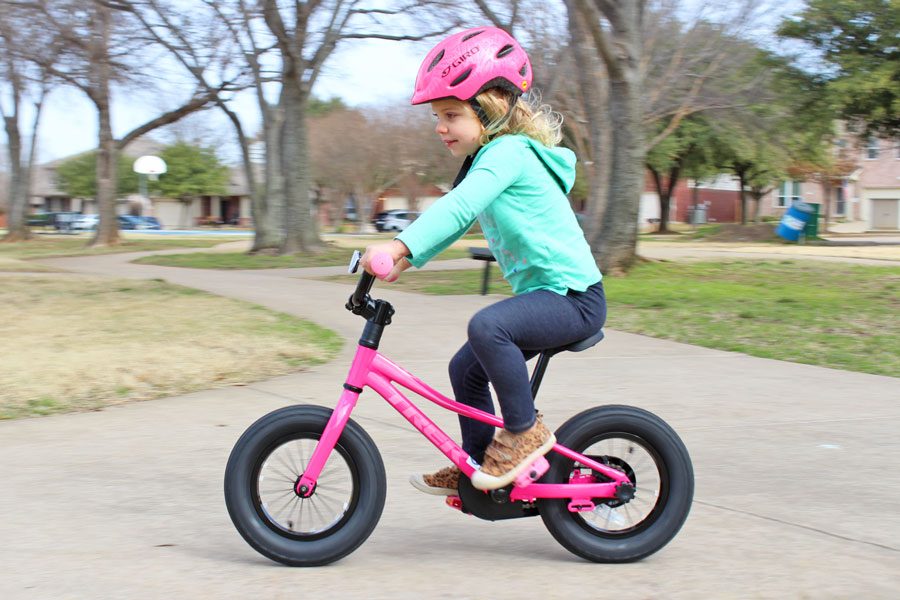
The Trek Precaliber 12 is one of the best designed 12″ bikes we’ve tested. It has a unique combination of shorter seat height, adjustable height handlebars, and longer frame, which make it a natural fit and ride for the youngest riders. That being said, we much prefer 14″ bikes for this age as the taller wheels allow for longer crank arms which prevent kids from constantly having the spin their legs out.
Low Seat Height
Its low minimum seat height allows very young riders to safely touch the ground with their feet, instead of just grazing the ground with their toes on a too-tall 12″ bike. For example, this 12″ Trek bike has a minimum seat height of 15.25″, while the REI Co-op REV 12 bike has a minimum seat height of 17.5″!
This lower seat also creates a lower center of gravity so that the child is sitting much more “in” the bike rather than perched on top. An additional benefit of this low center of gravity is that balancing and maneuvering the bike are significantly easier.
Long Wheelbase
The Precaliber’s long wheelbase provides ample room between the saddle and handlebars for a child to stretch out comfortably, and also contributes to easier and smoother maneuvering.
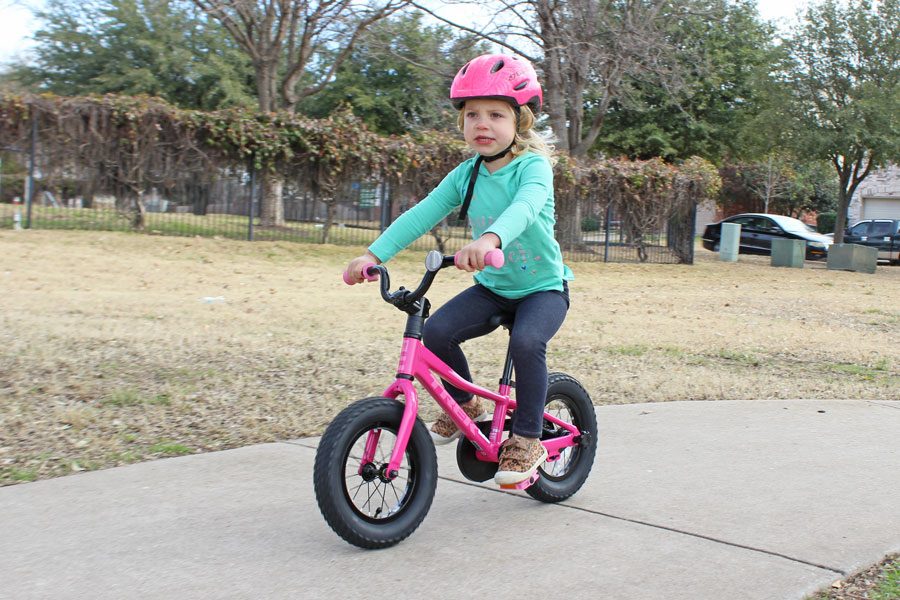
Adjustable Handlebars
With adjustable height handlebars, the Trek has a more customizable fit than most small bikes. This allows not just the saddle to be raised as a child grows, but the handlebars as well. (More on that below!)
Additionally, the handlebars can be rotated towards or away from the rider to adjust the distance a child has to reach to grab them.
Trek Precaliber 12 vs. REI REV 12
Look at this side-by-side comparison of the Precaliber 12 (left) and the REI Co-op REV 12 (right). Our little 3-year-old tester’s knees are practically on top of the handlebars on the REI bike. While the seat is only set about an inch above its minimum, she already has no room for growth.
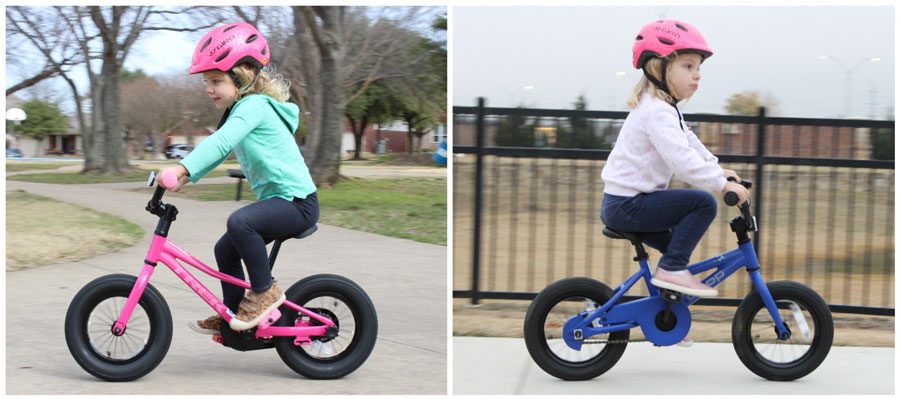
Contrast that with her positioning on the Trek. She has plenty of room to ride in comfort, and she’s actually riding with the seat set to its maximum height!
The Trek’s minimum seat height is 15.25″, while the REI REV 12’s is higher at 17.5″. A higher minimum seat height should indicate a larger bike designed to fit a taller rider. But clearly the REI REV is not proportioned for a taller rider.
Unfortunately, the sizing issue with REI’s 12″ bike is quite typical, which is why we generally tell parents to avoid 12″ bikes.
Sizing – Balance Bike Graduates vs. Training Wheels
Whether or not the Precaliber 12 is a good fit for your child depends a bit on if they will be using the bike with training wheels.
Balance Bike Graduates
This little pony is one of the very smallest pedal bikes on the market, making it a great option for young balance bike masters ready to take on the challenge of a “big kid bike.”
Transitioning from a balance bike to a pedal bike, a child should initially sit on the saddle and have legs straight and feet flat on the ground. This allows them to stop and start the bike with their feet, like they’re used to on a balance bike. It also makes it very easy to set their feet down without falling over.
Once a child has become a confident pedaler, you should raise the seat about an inch so that they are on their tip toes. This leg position creates optimal knee bend, and makes it much easier for a child to complete the pedaling motion.
With a minimum seat height of 15.25″, the Trek Precaliber 12 is an ideal purchase for balance bike graduates with inseams ranging from about 15″ – 16″. However, the lack of hand brakes makes the learning curve steeper than it needs to be (more on that below).
First Time Riders with Training Wheels
With balance bikes taking the world by storm, small bikes with training wheels are becoming something of a relic. With a minimum seat height of 15.25″, the Trek Precaliber is designed to fit a very small child, about 2 or 3 years old. While we much prefer balance bikes, we realize that for some kids they aren’t always an option.
If you do intend to use the Precaliber with training wheels, it’s best for a child to be able to comfortably touch the ground with their tip toes. This helps a child feel more confident, and also allows a child to set their feet down and prevent a fall if they get off balance. (This happens a lot with training wheels!)
As a result, the Precaliber with training wheels is a good purchase for kids with inseams ranging from about 14.25″ to 16″.
For more information on how to find a bike that is the perfect fit for your child, check out our Kids Bike Sizes Guide.
Training Wheels – On and Off in Seconds, No Tools!
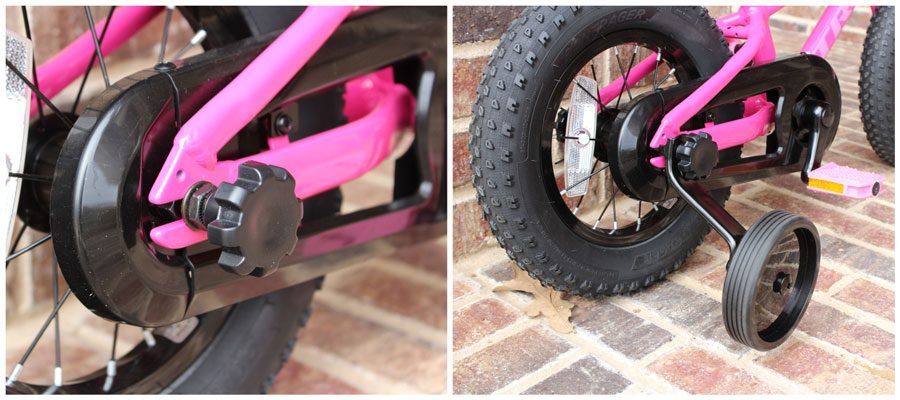
Speaking of training wheels… while we still think you should consider a balance bike instead, the training wheels on the Trek are some of the best we’ve seen.
A large black knob secures the training wheels to the rear axle. When it’s time to say goodbye to the training wheels, simply turn the knob to take them off. No tools! However, if you want to adjust the height of the training wheels up or down, you would need tools to loosen the bolt that connects the actual wheel of the training wheel to its arm.
Lightweight Aluminum Frame
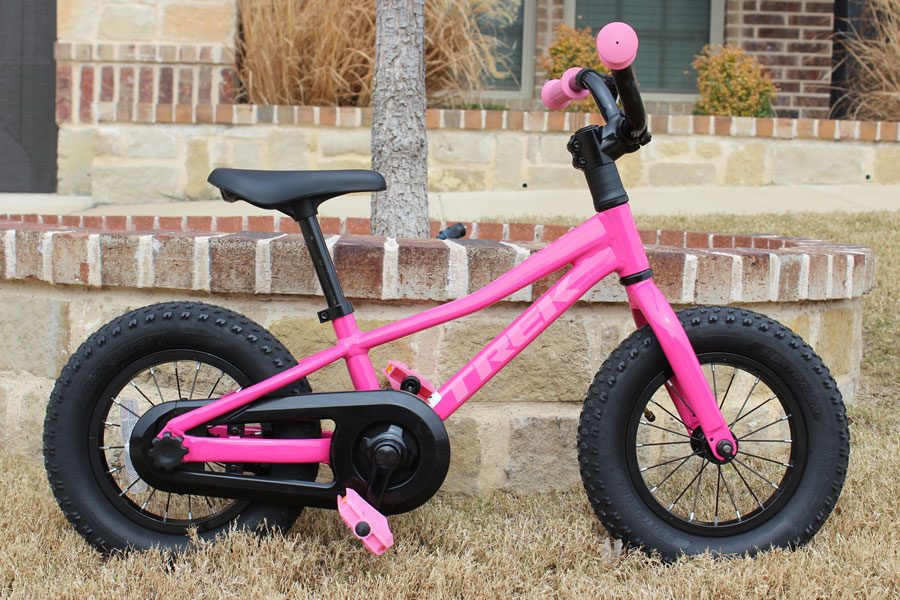
In the past, Trek kids bikes were quite heavy and cumbersome. Their steel frames were not doing them any favors. Heavy bikes are significantly more challenging to ride. Especially for kids. Especially for the littlest kids who are just learning to pedal!
With an aluminum frame, the Trek Precaliber 12 weighed in on our scale at just 15.08 pounds without training wheels. This is actually lighter than many 12″ bikes and comparable to some of our favorite lightweight 14″ bikes made for the same size child, like the Prevelo Alpha One.
Coaster Brake, No Handbrakes are Disappointing
Now we have to get real about the Precaliber 12’s most significant drawback: it has only a rear coaster brake and no hand brakes whatsoever. This is why the bike scores 0 out of 20 points in our brakes category, dragging down an otherwise solid performer.
Here’s why this matters:
For balance bike graduates: Coaster brakes make learning to pedal significantly more difficult and frustrating. We put our 3-year-old tester on this bike fresh off his balance bike. Like every little rider we’ve seen transition to pedals, he kept trying to pedal backwards and the coaster brake stopped him every single time.
When first learning to pedal, kids instinctively pedal both forwards and backwards because the motion hasn’t yet “clicked.” They also pedal backwards reflexively when trying to regain balance. A coaster brake stops them in their tracks every time, creating unnecessary frustration and delaying progress.
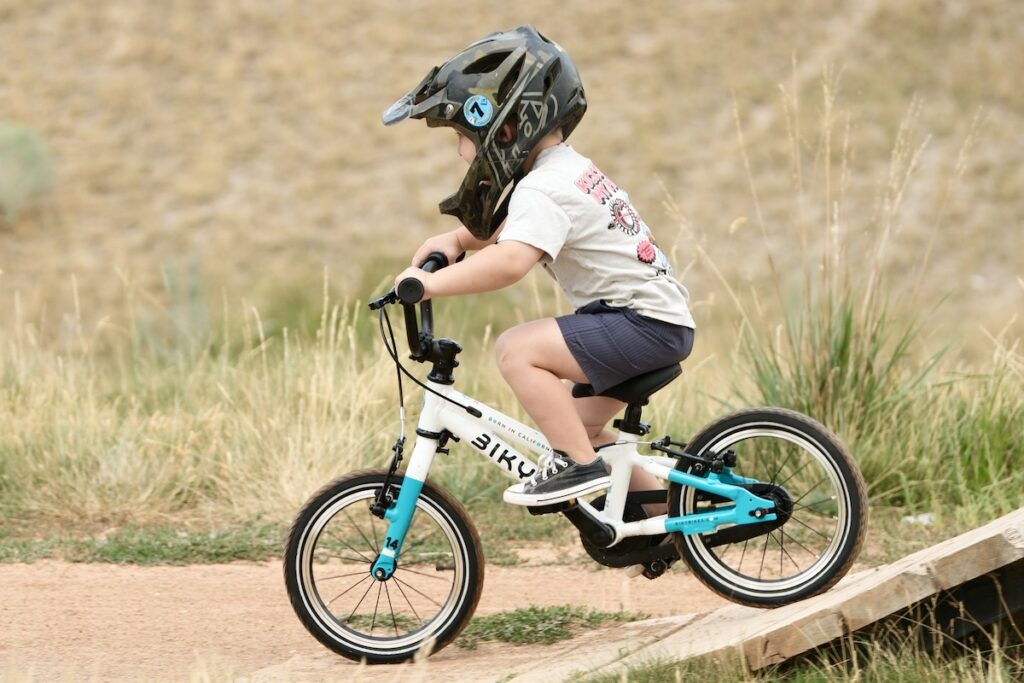
The hand brake advantage: Hand brakes allow kids to stop while still pedaling, coast freely, and develop proper braking technique they’ll use for life. Even young riders (2.5-3 years old) can learn to use hand brakes with short-reach levers designed for small hands. Bikes like the Biky Air 14 ($399) and Prevelo Alpha One ($489) prove that hand brakes work beautifully for this age group.
For training wheel users: If you’re planning to use training wheels, the coaster brake is less problematic since kids aren’t learning the pedaling motion from scratch. The training wheels provide stability, and kids typically pedal forward consistently when using them.
What we’d love to see: At this price point, we’d love Trek to add even just a single front hand brake. Many budget bikes now include both a coaster brake (to meet CPSC requirements) and a hand brake. Better yet would be offering a freewheel kit to remove the coaster brake entirely, like woom and other premium brands do.
Wide, Knobby Tires Great for Many Terrains
The Precaliber’s air tires are wide and knobby, offering great traction and cushioning on a variety of surfaces. From sidewalks to dirt trails, these tires are capable of handling mostly anything a 2 or 3-year-old can throw at them. However, due to the coaster brake and no hand brake, we don’t recommend this Trek kids bike for aggressive all-terrain riding.
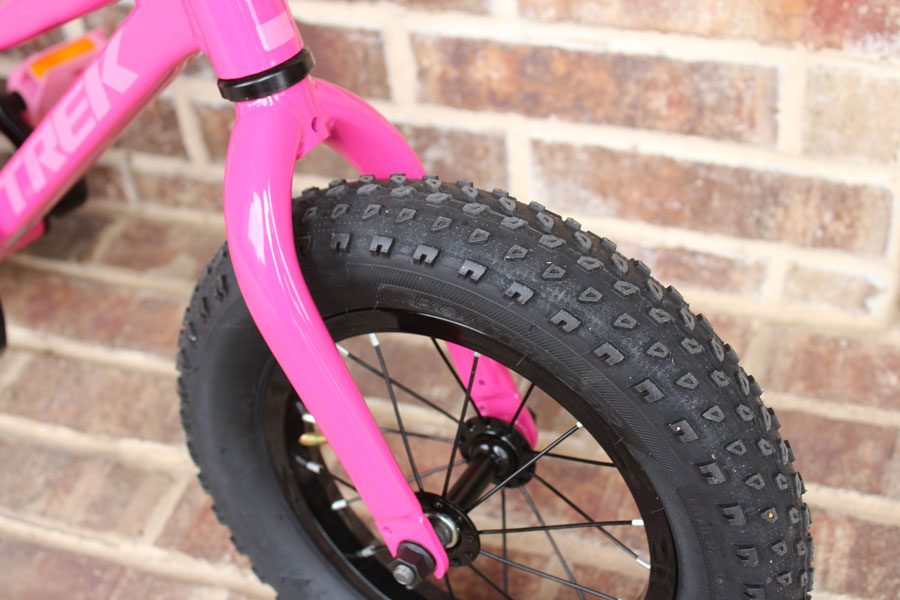
One small detail that is hugely helpful about these tires is that they have angled Schrader valves. Because 12-inch wheels are so small, they are a huge pain to inflate because the head of a bike pump often can’t fit in that tiny space. The angled valve is curved outward so you can attach the bike pump outside of the wheel!
Handlebars Adjustable for Height
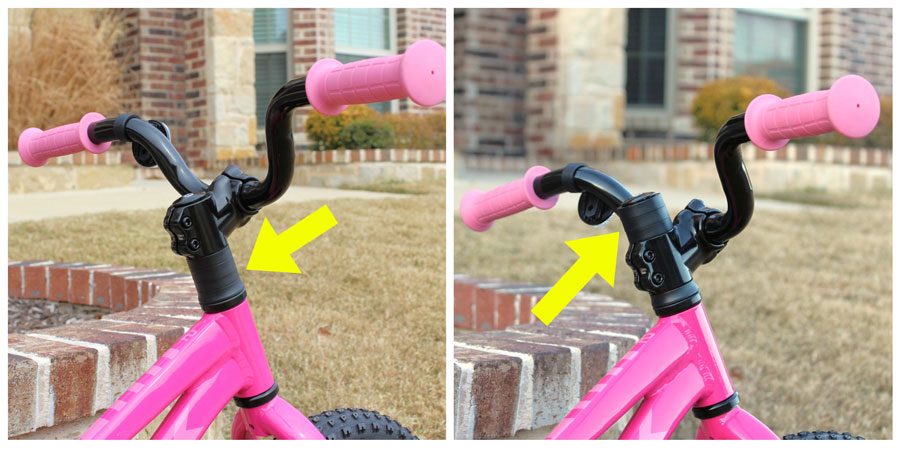
Many kids bikes have limited or no ability to adjust the height of their handlebars. As seen in these images, the Precaliber 12 has four spacer rings on the head tube. The top three spacers can be placed below or above the headset to raise or lower the handlebars. The bottom spacer is shaped differently and should be kept in place.
On the left, with all the spacers under the headset, the handlebars are raised as high as possible. On the right, with the three spacers on top of the headset, the handlebars are lowered to their lowest point.
For our 40.5″ tall tester with the seat height set at the max height, the handlebars set to their max height was an ideal fit.
For shorter riders who need the handlebars lowered, the handlebars can also be rotated slightly towards the child so that they are not only lower, but closer to their body.
Saddle and Seat Post
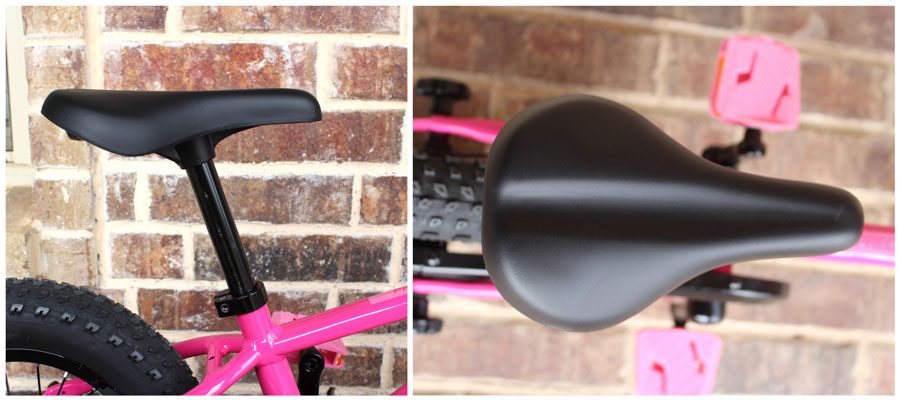
The saddle on the Precaliber is firm yet soft, and one of the better quality saddles we’ve seen. To raise or lower the saddle’s height, however, requires the use of an Allen key as there isn’t a quick release. It’s a minor inconvenience when making frequent adjustments as your child grows.
Grips and Pedals
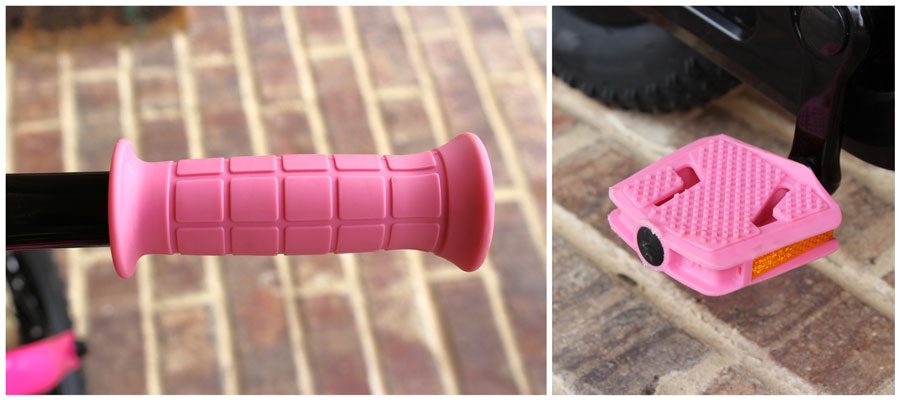
While a minor detail, the matching color accents of the Trek 12’s grips and pedals add a nice pop of color. Some small kids bikes have tiny pedals and grips that make using them more difficult. The Trek’s grips and pedals are both sized perfectly for 2 and 3-year-old riders.
Chainguard
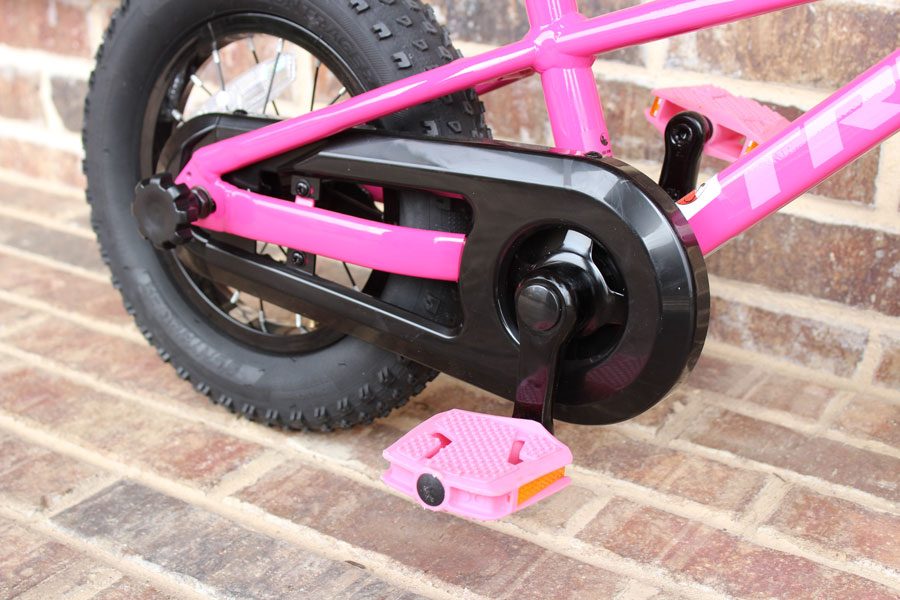
The full chain guard on the Trek Precaliber 12 keeps that greasy chain out of reach for little fingers and pants. We love the sleek visual of this full guard that covers the entire chain.
Bottom Line on the Trek Precaliber 12
If you’re planning to use training wheels, the Precaliber 12 is genuinely one of the best options available. The combination of lightweight design, quality training wheels, and Trek’s reputation makes it a solid choice for that use case. All in all, the Trek Precaliber 12 is a good bike that could easily be a great bike with the simple addition of a hand brake. The convenience of ordering online and picking up a fully assembled bike at your local bike shop, however, is also a major plus.
Who should look elsewhere: If your child is graduating from a balance bike and you want to continue developing their bike handling skills, we’d strongly recommend spending the same $299 on a bike with hand brakes. The Biky Air ($399) or the Prevelo Alpha One ($489), both with dual hand brakes, will provide a much better learning experience and score significantly higher in our testing (97.5 and 95.8 respectively). The Prevelo Alpha One even allows you to easily remove the crank arm to be used as a balance bike!
FTC Disclosure: Affiliate links are included in this review. No monetary compensation was provided for this review but Two Wheeling Tots received a bike from Decathlon to facilitate this review. All opinions and images are that of Two Wheeling Tots LLC. All content and images are copyrighted and should not be used or replicated in any way. View our Terms of Use.