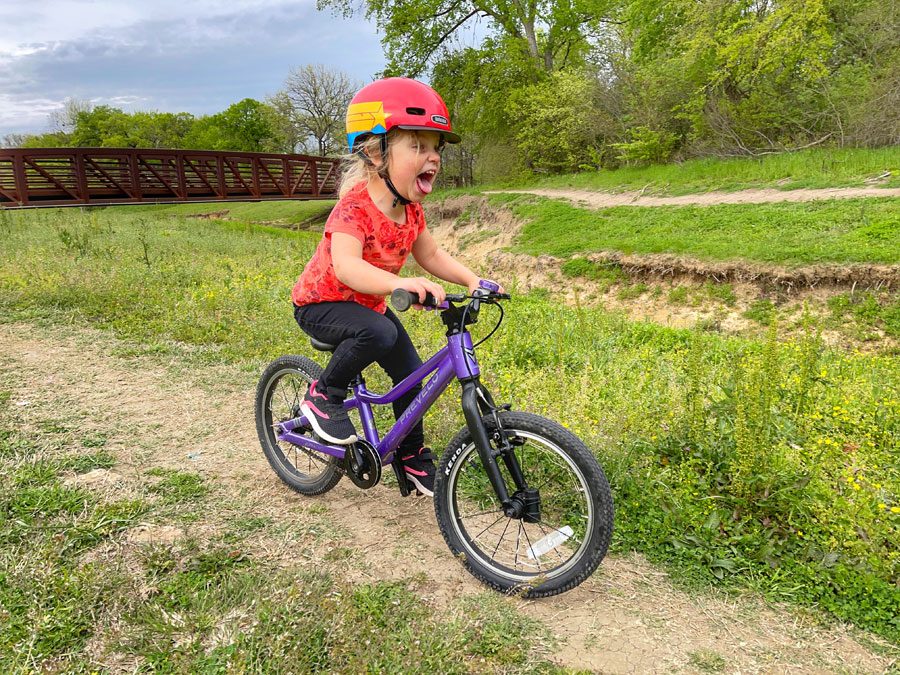
Early Rider Belter 16 Review: A Kids Bike That’s a True Work of Art

If you’ve never seen an Early Rider Belter, add it to your bucket list as they are museum-worthy mechanical marvels that perform as beautifully as they look! From the smooth, grease-free belt drive to the impeccably built pedals whose bearings spin for days, the Early Rider Belter 16 is sure to impress and they just keep getting better.
For 2025, Early Rider updated their already impressive bikes to make them even lighter, more agile, and more efficient. Designed for riders aged 4 to 6, the new Belter 16 is exceptionally crafted for adventurous kids ready for action. Its confidence-building geometry encourages kids to be playful and shift their weight naturally through turns.
For speed lovers, the Belter doesn’t disappoint, as its high gain ratio makes it one of the fastest 16 inch bikes on the market. And for kids eager for even more, the Belter 16 is also available with a 2-speed automatic hub that shifts into a higher gear as they pick up speed, giving young riders an even extra boost of speed.
From fit to function, there’s a lot to learn and even more to love about the Early Rider Belter 16. Let’s dive in!
Early Rider Belter 16
OUR SCORE: 90.4/100 – Exceptional

MSRP: $649, $699 (Auto model with geared hub)
BEST FOR: Adventurous riders in 4T to size 5 clothes
SEAT HEIGHT: 18.5″ – 22.5″
WEIGHT: 12.7 lb., 14.15 lb. (Auto)
ADDITIONAL SPECIFICATIONS
BRAKES: Tektro Dual Hand (no coaster brake)
GAIN RATIO: 4.01, 4.05 and 5.56 (Auto)
TRAINING WHEELS: Not compatible
FRAME: Aluminum Alloy
Cons:
Our 16 Inch Bike Rubric Score
We score each 16″ bike on a 100-point scale across seven areas. Most criteria are whether the bike has the feature or not. Weight and Fit Range are scored by comparing bikes in our dataset. Although the Belter is absolutely the best quality on this list, it did score lower than others mainly due to its smaller seat height range. See how other 16″ bikes scored on our Best 16″ Bikes page.
How the Early Rider Scored
Score Breakdown ▼
Weight 20.0 / 20 ▼
How it’s scored: Weight score is calculated proportionally, with the lightest bike in the comparison set receiving 20 points and the heaviest receiving 0 points.
Bike Weight: 12.83 lbs
Frame Design 20 / 20 ▼
What we evaluate: Evaluates the bike’s structural foundation and geometry. Points are awarded for features that reduce weight, lower the center of gravity, improve stability, and make the bike easier for young riders to mount and control.
- ✅ Aluminum Frame (4 pts)
- ✅ Low Bottom Bracket (3 pts)
- ✅ Low Min Seat Height (3 pts)
- ✅ Confidence Building Geometry (3 pts)
- ✅ Low Step-Through Frame (3 pts)
- ✅ Quality Paint & Graphics (2 pts)
- ✅ Threaded Bottom Bracket (2 pts)
Components 16 / 20 ▼
What we evaluate: Assesses the quality and appropriateness of parts that directly affect ride quality and durability. This includes drivetrain components (gear ratio, crank arm length, Q-factor), wheel quality, handlebar and saddle comfort, and practical features.
- ✅ Narrow Q-factor (3 pts)
- ❌ Schrader Tubes (2 pts)
- ✅ Quality Seat Post Quick Release (2 pts)
- ✅ Padded Kid Saddle (2 pts)
- ✅ Adjustable Handlebar (2 pts)
- ✅ Gain Ratio (2 pts)
- ✅ Crank Arm Length (2 pts)
- ✅ Sealed Bottom Bracket (2 pts)
- ❌ Rattle-free Chain Guard (1 pt)
- ❌ Kickstand Included (1 pt) <
- ✅ Grips with Protective Bumper End (1 pt)
Brakes 19 / 20 ▼
What we evaluate: Focuses on stopping power and safety. Prioritizes hand brakes over coaster brakes, rewards features that make brakes easier for small hands to operate, and values brake system redundancy.
- ✅ No Coaster Brake (4 pts)
- ✅ Short Reach Brake Levers (4 pts)
- ✅ V-Pull Brakes (4 pts)
- ✅ Easy Pull Levers (3 pts)
- ✅ Alloy Brake Levers (2 pts)
- ✅ Brake Duplicity (2 pts)
- ❌ Tool Free Adjustable Reach Levers (1 pt)
Fit Range 4.4 / 10 ▼
How it’s scored: Bikes with wider seat height ranges score higher on a proportional scale, where the widest range scores 10 points and the narrowest scores 0 points.
Minimum Seat Height: 18.5″
Maximum Seat Height: 22.5″
Total Range: 4.0″
Ease of Assembly 6 / 6 ▼
What we evaluate: Measures how parent-friendly the out-of-box setup is. Points are given for clear instructions, minimal assembly requirements, and pre-tuned brakes.
- ✅ Clear Written Instructions (2 pts)
- ✅ Video Instructions (2 pts)
- ✅ Easy Assembly (1 pt)
- ✅ Pre-tuned Brakes (1 pt)
Customer Service 4 / 4 ▼
What we evaluate: Evaluates the manufacturer’s post-purchase support. Bikes earn points for responsive customer service, frame warranties, and component coverage.
- ✅ Customer Service with Phone Number (2 pts)
- ✅ Frame Warranty (1 pt)
- ✅ Partial Component Warranty (1 pt)
Extra Credit +1 ▼
What earns extra credit: Bonus points for innovative features that enhance versatility or usability beyond standard expectations.
- ❌ Easily Converts to Balance Bike (+1 pt)
- ✅ Belt Drive (+1 pt)
- ❌ Color Coded Levers/Cables (+1 pt)
- ❌ Rear Placed Kickstand (+1 pt)
What We Love about the Early Rider Belter 16
- Lightweight and Nimble: Built for speed and performance, the Belter combines top-tier components with a remarkably light frame.
- Confidence-Building Geometry: The low bottom bracket and slack head tube angle give young riders the freedom to be playful and agile.
- Functional Artwork in Action: The Belter isn’t just a bike, it’s a stunning piece of engineering that rides as beautifully as it looks.

- Minimal Maintenance: The grease-free belt drive glides smoothly and quietly with minimal, if any, upkeep for years to come.
- Auto Shift 2-Speed Hub: The optional internally geared hub automatically shifts to a higher gear once a child reaches a certain cadence, jumping the gain ratio from 4.01 to 5.53—a huge increase! This prevents kids from spinning their legs at high speeds and allows the bike to cover ground faster.
- Urban and Trail Options: Early Rider also offers the Seeker 16, which uses the same frame as the Belter 16 but adds knobby tires and hydraulic disc brakes for true trail riding.
What you Should Know About the Early Rider Before you Buy
- Aggressive Positioning: Built for adventurous city riders, the Belter encourages a slightly leaned-in stance that may feel too forward for timid riders. The 2025 update, however, makes this position feel more natural. Confident and active riders will love it; very cautious riders may prefer a more upright bike.
- Mild Mixed-Use Tires: The Schwalbe Billy Bonkers tires roll smoothly on pavement yet maintain traction in light dirt and wet conditions. For true off-road grip, check out the Early Rider Seeker 16.
- No Chain Guard: While there’s no greasy chain to cover, baggy clothing can still catch on the exposed belt. Stick to fitted pants or shorts for safe riding.
Belter 16 2024 vs. Belter 16 2025
The 2025 update to the Early Rider Belter 16 is a big one. Both versions are exceptional, but the latest model introduces several key geometry refinements that aren’t obvious in stock photos. In the overlapping image below, you can see just how different the new 2025 Belter (silver frame) is compared to the 2024 model (purple frame).

The 2025 Belter features a lower top tube for easier on’s and off’s, a lower bottom bracket for improved stability, and a slacker head-tube angle that gives the bike a more planted, confidence-inspiring ride. These subtle updates make the new Belter feel even more agile and balanced, especially for playful riders who love leaning through turns or tackling small jumps.
| Belter 2025 | Belter 2024 | |
|---|---|---|
| Seat Height | 18.5” – 22.5” | 19.5” – 23.5” |
| Weight | 12.83 lb | 13.7 lb |
| Head Tube Angle | 67 | 69.5 |
| Seat Tube Angle | 72 | 71 |
| Wheelbase | 750 mm | 710 mm |
| Chainstay Length | 287 mm | 282 mm |
What size and age of child fits on the Belter 16?
The Early Rider Belter 16 has a seat height range of 18.5″ to 22.5″, making it the best fit for kids with inseams between 17″ and 21″, depending on their experience level. (How to measure a child’s inseam for a bike)
- New pedalers: For kids just learning to ride, an inseam of at least 18.5″ is ideal. This allows both feet to rest flat on the ground for easy starts, stops, and fewer nerves while learning.
- Experienced riders: Confident riders who can already start and stop on their own can comfortably fit the Belter with an inseam as short as 17″.
For visual reference in the image below, our shorter 4-year-old tester (40″ tall, about a 17.5” inseam) on the left rode comfortably at the minimum 18.5″ seat height, while our taller 4-year-old tester (44″ tall, about 19.5” inseam) on the right rode with the seat set to 21″.

If your child is taller for their age, note that riders with inseams above 20.5″ may be better suited to the Early Rider Belter 20, which offers more room to grow. When we tested both models, our 4-year-old with a 19.5″ inseam much preferred the smaller Belter 16. On the Belter 20, he couldn’t quite touch the ground with both toes at its 22.5″ minimum seat height, making starts and stops less comfortable.

Real-World Testing: Why Kids (and Parents) Love It
I first reviewed the Early Rider Belter 16 nearly a decade ago, and even back then it blew us away. Fast forward to 2025, and the new Belter has taken everything we loved and dialed it up even more! The updates aren’t just incremental, they’ve made an already fantastic bike genuinely phenomenal. The numbers look great, but how does it perform?
When our 43” tall 4-year-old tester first threw a leg over the new Belter, I expected a cautious few minutes of warming up. Instead, within minutes, he was riding the bike like he’s owned it for years! Without skipping a beat he was confidently leaning into turns, powering up driveways, standing up to pedal and enjoying every minute of it.

All that hesitation we’d seen earlier in the year when he was just getting started on a pedal bike had vanished. He looked completely at home on the bike, smooth and relaxed, as he glided through the neighborhood.
Then came the moment that sealed it: he leaned so deep into a corner that one of the pedals clipped the pavement. Normally, a pedal strike would be a red flag for a bike due to bad design, but in this case, it meant the exact opposite. Our tester felt that confident on the Belter, leaning hard into the turn and truly riding the bike rather than just sitting on it.

After that, he turned to me with a huge grin and asked, “Do you have a ramp?” How do you say no to that? A few minutes later, he was flying off a small ramp, skidding out the backside, laughing, and shouting, “Did you see that?!” Watching him progress from tentative pedaler to fearless trick-seeker on the Belter was beyond fun to watch.

We also tested the Belter with three additional 4-year-old testers. While they weren’t as daring as our first rider, but the experience was very similar, no awkward starts, no “getting used to it,” just smooth pedaling and instant smiles. The Belter’s lightweight frame and balanced geometry make it easy for kids of all confidence levels to feel comfortable and capable from the very first push.

While the Belter 16 really shines under adventurous riders who love to lean, jump, and explore, it’s also a quiet confidence-builder for more cautious kids. The bike’s low center of gravity and feather-light build give them an impressive sense of control, often without them even realizing how much the bike itself is helping them out.
Belter 16 Geometry: What makes it so good?
A lightweight frame, low center of gravity, and slack head-tube angle are a dream combination on a mountain bike and they work wonders on a kids’ bike, too. It’s not just marketing speak; it’s physics! The Belter’s slacker fork stretches the wheelbase, creating a wider, more stable platform while allowing the rider to sit lower in relation to the wheels. This lowers the child’s center of gravity, making the bike noticeably easier to balance, especially at slower speeds where most kids still struggle.
Paired with its lower handlebar position, the Belter 16 is remarkably easy to lean, balance, and maneuver. Low handlebars are ideal for young, aggressive riders as it allows them to lean into the bike and shift their weight through turns or small jumps. With the Belter’s longer wheelbase and slacker front end, that lower bar position becomes an asset by letting riders naturally lean into the front wheel for better traction when riding up curbs, over ramps, or down short descents.
Even though the photos below show the older Belter, the handlebar position hasn’t changed on the 2025 model. You can clearly see how much more our 6-year-old tester can lean into the Belter (left) compared to the more upright bikes (Biky 16 in center and woom GO 3 on the right). That lower stance gives the Belter a fast, “ready-for-action” feel.

For kids just starting on a pedal bike, however, the more aggressive, leaned-in geometry of the Belter may be too much for naturally timid riders. Timid riders tend to prefer to sit upright and keep their weight centered over their hips, as shown on the teal woom GO 3 below.

If your young grom already zips around confidently on a balance bike or loves a little speed, don’t hesitate to let the Belter 16 be their first pedal bike. Its more aggressive stance likely won’t faze them, in fact, it will probably make them feel right at home. But if your child is still tentative, a more upright option like the woom GO 3 or Biky 16 will likely feel more natural at first.
How fast is the Belter 16?
The Early Rider Belter 16 isn’t just playful, it’s also fast. With a gain ratio of 4.02, it covers more ground per pedal stroke than most other 16-inch bikes, including the woom GO 3 and Prevelo Alpha Two (both around 3.8). That extra gearing means less frantic spinning and more smooth cruising, whether your child’s racing siblings down the street or chasing you up the trail.
It’s especially noticeable when kids start standing up to pedal or riding ramps. The bike just goes. You can see it in their smiles, that feeling of effortless speed that is likely to become a staple childhood memory.
And if your young speed-seeker is always asking to go “just a little faster,” the Belter 16 Auto takes it up another notch. Its automatic 2-speed internal hub shifts gears on its own once the rider reaches a certain cadence, jumping from a 4.01 to a 5.56 gain ratio, roughly a 39% boost in distance per pedal stroke.
We didn’t have the chance to test the Belter 16 Auto, but we did test the Belter 20 Auto, which uses the same internally geared hub. Based on that experience, we can confidently say the auto-shift system works seamlessly.
Belter’s Components and Exceptional Craftsmanship
If you’re a sucker for craftsmanship, the Early Rider Belter 16 will absolutely win you over. Every inch of this bike, every bearing, pedal, and brushed aluminum tube, feels like it was built by someone who truly cares about bikes.
It’s the kind of design that makes both parents and kids stop mid-ride just to admire it. We’ve tested hundreds of kids’ bikes over the years, but few have impressed us like the Belter. It’s not just a collection of high-end parts, it’s the way those parts work together. From the first push of the pedals, the whole bike feels silky smooth and effortless.
A Whisper-Quiet Belt Drive That Just Keeps Going
The star of the show is the Gates carbon-fiber belt drive. It replaces the traditional chain and runs whisper quiet—so quiet, in fact, that one of our 5-year-old testers proudly dubbed his the “ninja bike.” No greasy mess, no chain slap, no maintenance headaches. Just a smooth, steady ride that makes every pedal stroke feel smooth and easy.

And this isn’t just marketing talk. We pulled out our original Belter 16 from nearly ten years ago, one that had been left grimy and neglected for far too long, and it still pedaled beautifully. Sure, it was covered in dirt, but the belt ran smoothly without skipping or squeaking, a true testament to how durable these drivetrains are.

While we definitely don’t recommend treating your Belter like that one (please don’t leave it outside all winter!), it’s reassuring to know that the belt system can handle a little real-world kid wear and tear and keep on rolling.
Smooth-Rolling Tires and Confident Grip
The 2025 Belter comes equipped with Schwalbe Billy Bonkers 2″ tires, and they’re as fun as their name implies. These mixed-use tires roll fast on pavement but still grip well on compact dirt and wet surfaces. They’re perfect for neighborhood rides that might veer off the sidewalk and onto a dirt path or driveway jump.

If your family rides mostly trails, Early Rider’s Seeker 16 (built on the same frame) swaps those out for knobbier all-terrain tires and hydraulic disc brakes for even more off-road control.
Bearings That Set the Standard
Early Rider was the first kids’ bike brand to switch to sealed cartridge bearings instead of traditional cup-and-cone hubs, a small detail that makes a big difference. Sealed bearings roll smoother, resist dirt and grime better, and require almost no maintenance. It’s part of why the Belter feels so smooth under every rider, year after year.
Impressive, Show-Stopping Pedals
Pedals rarely get mentioned in our reviews, but these pedals are something else! In addition to looking smooth and sleek, it’s what you can’t see that really makes a difference. These durable resin pedals spin faster and longer than the pedals on my high-end adult bike!

The only pedals we’ve seen spin a bit faster are the metal ones on that old, neglected, 10-year-old Belter! 🤣
What We Don’t Love about the Early Rider Belter 16
Lack of Chain Guard on Early Rider Belter
One concern we have about the Belter is the absence of a chain guard (or belt guard). The CPSC mandates that all small kids’ bikes should have a chain guard to prevent clothes from getting caught in the chain. Since the Belter uses a belt drive instead of a chain, it technically doesn’t require a chain guard.
However, it’s important to note that the belt drive can still pose a similar risk of trapping clothes. We encountered this issue during our initial tests with the Belter 16 ten years ago when my son’s pants got caught in the belt, causing him to fall.

While baggy kids’ pants are less common nowadays, we still advise against riders wearing baggy pants, skirts, or dresses while using the Belter 16 to be safe.
Early Rider vs. Competitors
If your young rider is eager to take on every biking adventure that comes their way, the Early Rider Belter 16 is an excellent choice. Its aggressive stance, lightweight build, and high gain ratio make it a top pick for ambitious kids who love to push their limits.
Compared to other premium bikes like the Prevelo Alpha Two and woom GO 3, the Belter 16 is similar in both weight and seat height, but its exceptional build quality and craftsmanship do come at a higher price.
| Belter 16 | Prevelo Alpha Two | woom GO 3 | |
| MSRP | $699 | $509 | $499 |
| Weight | 12.83 lb. | 12.9 lb. | 13.1 lb. |
| Seat Height | 18.5″ – 22.5″ | 17” – 24.75″ | 18.75″ – 25.2″ |
| Gain Ratio | 4.01 | 3.8 | 3.88 |
As mentioned earlier, the geometry of these bikes differs significantly. The woom GO 3 is designed for more timid riders who prefer an upright, relaxed position, while the Early Rider Belter 16 and Prevelo Alpha Two cater to confident, adventurous kids who like to move dynamically on the bike.
The Belter 16, however, has a bit more of an aggressive geometry with a slacker head-tube angle and a slightly longer wheelbase that give it a more planted, stable feel in corners and when riding at higher speeds. These differences make it especially well-suited for kids who love to lean, carve, and really ride their bike rather than simply pedal along.

The Prevelo Alpha Two does have a few advantages of its own, including a lower minimum seat height that makes it accessible to smaller riders and a clever balance-bike conversion kit that extends its usability. But for kids seeking that high-performance, “one with the bike” feel, the Belter 16 remains in a class of its own.
Belter 16 Auto vs. woom GO 3 Automagic
If you’re considering an automatic 2-speed 16-inch bike, both the Early Rider Belter 16 Auto and the woom GO 3 Automagic are fantastic options. Each uses an internal hub that automatically shifts into a higher gear once the bike reaches a certain speed, no shifters, no levers, just smooth, seamless transitions.
The key difference comes down to gearing and ride feel. The woom GO 3 Automagic starts in a much easier first gear, making it ideal for beginners or timid riders who need a gentle start. Once up to speed, it shifts into a moderate cruising gear for a comfortable ride.
The Belter 16 Auto, on the other hand, starts in what feels like a regular riding gear and then shifts into a noticeably faster one. Its higher gearing gives it a snappier, more performance-oriented feel that’s perfect for confident riders who love to pick up speed and chase older siblings down the street.
| Belter 16 Auto | woom GO 3 Automagic | |
| MSRP | $699 | $549 |
| Weight | 14.15 lb. | 14.4 lb. |
| Seat Height | 18.5″ – 22.5″ | 18.75″ – 25.2″ |
| Gain Ratio | 4.05 – 5.56 | 3.2 – 4.4 |
Early Rider Belter 16 Bottom Line
Beautifully crafted and a joy to ride, the Early Rider Belter 16 is the kind of bike that makes you wish you were a kid again. Its lightweight frame, precision engineering, and aggressive geometry come together to create a ride that feels fast, responsive, and just plain fun.
With its higher gain ratio and confident, leaned-in riding position, the Belter 16 is best suited for speed-loving, adventurous kids who wear at least 4T pants and aren’t afraid to push the pace. It’s more than just a kids’ bike, it’s a high-performance machine built to fuel big adventures and even bigger smiles. After all “Life’s an Adventure, Start Early”!

FTC Disclosure: Affiliate links are included in this review. No monetary compensation was provided for this review, however, the reviewed product was supplied by the manufacturer or distributor to help facilitate this review. All opinions and images are that of Two Wheeling Tots LLC. All content and images are copyrighted and should not be used or replicated in any way. View our Terms of Use.