

woom GO 3 and AUTOMAGIC Review — Our Favorite Bikes for Beginners!

If every kid had a woom GO 3, elementary school bike racks would be overflowing—and the carpool lane would be wide open. Why? Because after starting their biking journey on the GO 3, kids would want to ride to school.
Unlike many first pedal bikes that are heavy, clunky, or hard to handle, the woom GO 3 inspires confidence and joy from day one. Gone are the days of watching your child tip over in frustration or complain that biking is just too hard. From its ultralight frame to its thoughtfully designed, kid-specific components, every part of the GO 3 is engineered to make riding easier, more intuitive, and a whole lot more fun.
The GO 3 is the newly updated version of the beloved woom 3, and it brings several smart upgrades to an already outstanding design. In this review, we’ll cover what’s new, how the GO 3 stacks up against other top 16” bikes, the key differences between the original GO and the GO AUTOMAGIC (with its 2-speed hub), and—most importantly—what types of riders this bike is best suited for.
woom GO 3
OUR SCORE: 96.2/100 – Exceptional

MSRP: $499, $549 (AUTOMAGIC – 2 gear version)
BEST FOR: Balance bike graduates in at least 4T pants. Upright position makes it better suited for timid and average riders
SEAT HEIGHT: 19.1″ – 25.2″
WEIGHT: 13 lb. (without pedals and kickstand), 14.4 lbs. (AUTOMAGIC 2-geared model)
ADDITIONAL SPECIFICATIONS
BRAKES: Dual Hand Brake (No coaster brake)
FRAME: Aluminum Alloy
GAIN RATIO: 3.8
TRAINING WHEELS: Not compatible
Cons:
Our 16 Inch Bike Rubric Score
We score each 16″ bike out of 100 points across seven categories. Most features are yes/no: the bike either has it or doesn’t. Weight and Fit Range are scored by ranking bikes against each other. This score is for the standard woom GO 3. The GO 3 AUTOMAGIC scores slightly lower due to its heavier automatic shifting hub, but for speedier riders, the convenience is worth the trade-off. See how other 16″ bikes scored on our Best 16″ Bikes page.
How the woom Scored
Score Breakdown ▼
Weight 19.6 / 20 ▼
How it’s scored: Weight score is calculated proportionally, with the lightest bike in the comparison set receiving 20 points and the heaviest receiving 0 points.
Bike Weight: 13.00 lbs
Frame Design 20 / 20 ▼
What we evaluate: Evaluates the bike’s structural foundation and geometry. Points are awarded for features that reduce weight, lower the center of gravity, improve stability, and make the bike easier for young riders to mount and control.
- ✅ Aluminum Frame (4 pts)
- ✅ Low Bottom Bracket (3 pts)
- ✅ Low Min Seat Height (3 pts)
- ✅ Confidence Building Geometry (3 pts)
- ✅ Low Step-Through Frame (3 pts)
- ✅ Quality Paint & Graphics (2 pts)
- ✅ Threaded Bottom Bracket (2 pts)
Components 20 / 20 ▼
What we evaluate: Assesses the quality and appropriateness of parts that directly affect ride quality and durability. This includes drivetrain components (gear ratio, crank arm length, Q-factor), wheel quality, handlebar and saddle comfort, and practical features.
- ✅ Narrow Q-factor (3 pts)
- ✅ Schrader Tubes (2 pts)
- ✅ Quality Seat Post Quick Release (2 pts)
- ✅ Padded Kid Saddle (2 pts)
- ✅ Adjustable Handlebar (2 pts)
- ✅ Gain Ratio (2 pts)
- ✅ Crank Arm Length (2 pts)
- ✅ Sealed Bottom Bracket (2 pts)
- ✅ Rattle-free Chain Guard (1 pt)
- ✅ Kickstand Included (1 pt)
- ✅ Grips with Protective Bumper End (1 pt)
Brakes 18 / 20 ▼
What we evaluate: Focuses on stopping power and safety. Prioritizes hand brakes over coaster brakes, rewards features that make brakes easier for small hands to operate, and values brake system redundancy.
- ✅ No Coaster Brake (4 pts)
- ✅ Short Reach Brake Levers (4 pts)
- ✅ V-Pull Brakes (4 pts)
- ✅ Easy Pull Levers (3 pts)
- ❌ Alloy Brake Levers (2 pts)
- ✅ Brake Duplicity (2 pts)
- ✅ Tool Free Adjustable Reach Levers (1 pt)
Fit Range 7.6 / 10 ▼
How it’s scored: Bikes with wider seat height ranges score higher on a proportional scale, where the widest range scores 10 points and the narrowest scores 0 points.
Minimum Seat Height: 18.8″
Maximum Seat Height: 25.2″
Total Range: 6.4″
Ease of Assembly 6 / 6 ▼
What we evaluate: Measures how parent-friendly the out-of-box setup is. Points are given for clear instructions, minimal assembly requirements, and pre-tuned brakes.
- ✅ Clear Written Instructions (2 pts)
- ✅ Video Instructions (2 pts)
- ✅ Easy Assembly (1 pt)
- ✅ Pre-tuned Brakes (1 pt)
Customer Service 3 / 4 ▼
What we evaluate: Evaluates the manufacturer’s post-purchase support. Bikes earn points for responsive customer service, frame warranties, and component coverage.
- ✅ Customer Service with Phone Number (2 pts)
- ✅ Frame Warranty (1 pt)
- ❌ Partial Component Warranty (1 pt)
Extra Credit +2 ▼
What earns extra credit: Bonus points for innovative features that enhance versatility or usability beyond standard expectations.
- ❌ Easily Converts to Balance Bike (+1 pt)
- ❌ Belt Drive (+1 pt)
- ✅ Color Coded Levers/Cables (+1 pt)
- ✅ Rear Placed Kickstand (+1 pt)
woom 3 Review – Results of our Test Rides
We’ve tested every version of the woom 3 since it first hit the market back in 2015. At this point, we’ve lost count of the exact number of test rides—or even how many different woom 3s we’ve put through their paces—but one thing has remained the same: the woom 3 (formerly the woom ORIGINAL 3, now the woom GO 3) continues to reign as our top pick for beginning riders.
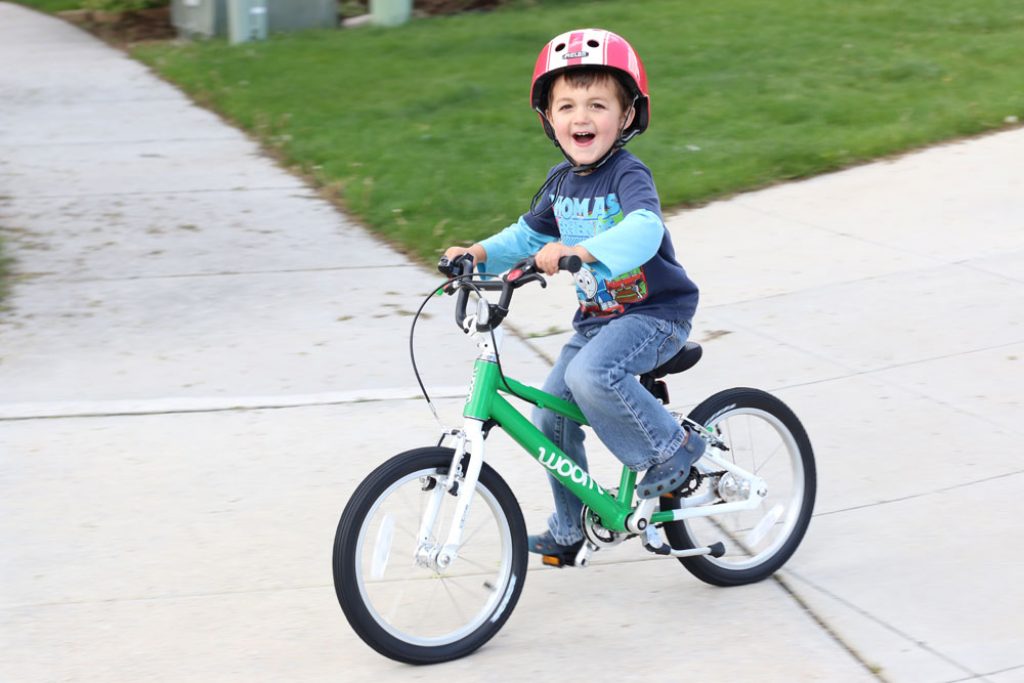
From frame geometry to kid-specific components, everything about the GO 3 is thoughtfully designed to help young riders build confidence and skill from the very beginning. But before we dive into all the specs, let’s answer a common question we get from parents:
Who is the woom GO 3 Best For?
- Beginning riders—especially timid ones. The GO 3’s upright geometry puts kids in a stable, confidence-inspiring position that’s perfect for those just learning to ride. While it’s excellent for cautious or first-time riders, aggressive kids seeking speed or off-road thrills may outgrow it quickly.
- Everyday neighborhood riders. The all-terrain tires handle compact dirt and gravel trails just fine, but the GO 3 is best on pavement and smooth paths—not technical or rugged terrain.
- Families looking for long-term value. The GO 3 is built to last through multiple kids.
- Young treasure collectors. The GO 3 is compatible with the beloved woom POP basket—perfect for hauling snacks, stuffed animals, or playground finds.
- Kickstand fans. Rare for a high-end kids’ bike, the GO 3 includes a kid-friendly kickstand that’s thoughtfully designed to stay out of the way of the pedal stroke and pops up automatically if forgotten.
What Size Child Will Fit on the woom GO 3?
The woom GO 3 and GO 3 AUTOMAGIC have a seat height range of 18.75″ to 25.75″, making them a great fit for most kids between 4 and 6 years old.
For First-Time Pedal Bike Riders
The GO 3 is ideal for children with an inseam of 19″ to 20″. For brand-new riders, we recommend setting the seat height equal to or just under their inseam. This allows them to plant their feet flat on the ground for easy starts, stops, and extra confidence—especially helpful for timid riders.
For Experienced Riders Moving Up
If your child is graduating from a 12″ or 14″ bike and already knows how to pedal, the GO 3 works well for inseams ranging from 17″ to 21″. For the best pedaling efficiency, set the seat about 2″ above your child’s inseam. This will give them proper leg extension while still allowing them to touch the ground with their toes when seated—plus some extra room to grow.
For reference: Our little tester here is 41” tall with a 17.5” inseam. She’s an experienced rider and can touch the ground with her tiptoes while seated.

Not sure how to measure your child’s inseam? Check out our Kids Bike Size Guide for a simple step-by-step!
How Long Will My Child Fit on the woom GO 3?
In our experience over the past 5+ years of testing, most kids get about two years of use out of the woom 3—right in line with other quality 16” bikes.
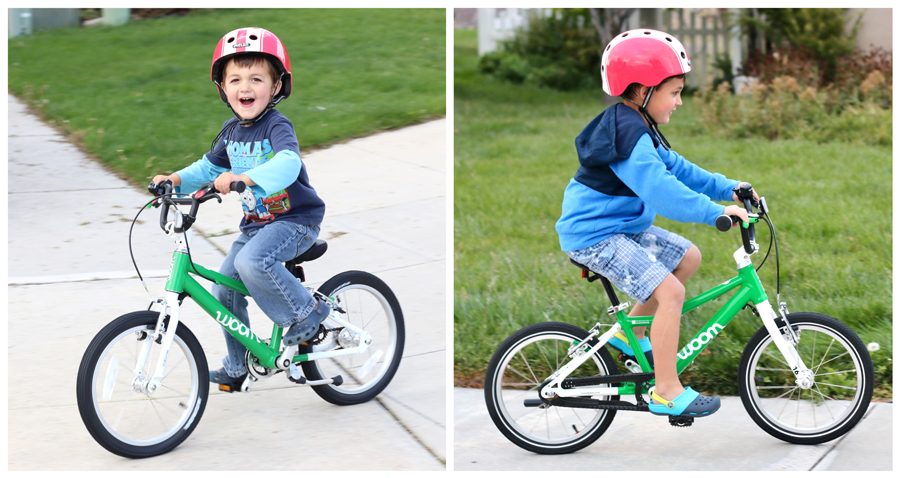
Our tester shown below started riding the woom 3 at age 4, and by age 6 (almost 7), was still riding it comfortably. That said, by then he was ready to level up to the larger 20” woom 4.
What’s the Difference Between the GO 3 and the GO 3 AUTOMAGIC?
The GO 3 and GO 3 AUTOMAGIC are identical in size, geometry, and overall design—but differ in one important way: the AUTOMAGIC model features a 2-speed internally geared hub.
This special hub automatically shifts to a higher gear once your child reaches a certain speed—no levers, buttons, or shifting skills required. The transition is smooth and intuitive, making it a great option for kids who love to ride fast but aren’t ready to manage gears on their own.
The standard GO 3 has a single gear with a 3.85 gain ratio, which sits right between the AUTOMAGIC’s two gears—starting at 3.2 and shifting up to 4.4.. The switch to a higher 4.4 gain ratio makes the AUTOMAGIC better suited for riders on flat terrain wanting to ride faster versus riders needing a lower gear for climbing hills.
We’ll go into more detail about the AUTOMAGIC in this section of our review.
What Makes the woom GO 3 so Exceptional?
We’ve tested hundreds of kids’ bikes over the years, and while there are plenty of great options out there, few are as thoughtfully dialed in for beginning and timid riders as the woom GO 3.
Every feature on the GO 3 has been carefully refined over time to create a smooth, confidence-building riding experience. Its thoughtful frame geometry and upright handlebars help kids maintain a stable, comfortable posture that makes balancing easier and less intimidating.

The ergonomic saddle and grips are designed with small bodies in mind, offering comfort on both short spins and longer rides. And for kids still mastering their left from right, the color-coded brake levers—green for the rear and black for the front—make learning to use dual hand brakes much easier.
And if the ride quality doesn’t win you over, the little extras just might. At just 13 pounds, the GO 3 is one of the lightest 16” pedal bikes on the market—making it easier for kids to ride and for parents to carry. It also comes with a kid-friendly kickstand (rare on high-end bikes!) and is compatible with the beloved woom POP basket, perfect for hauling snacks, stuffies, or park-day treasures.
Woom GO 3 – Major Highlights
Lightweight
When it comes to kids’ bikes, weight makes a huge difference. Since children are so much lighter than adults, even small increases in bike weight can significantly impact their ability to balance, maneuver, and enjoy the ride.
At just 13 pounds (with pedals and kickstand), the woom GO 3 is the lightest full-featured 16” bike we’ve tested. While the Biky 16 edged in slightly lighter on our scale at 12.4 pounds, it doesn’t include a kickstand—making the woom the lightest 16″ option with a complete feature set.
Other popular models may be light compared to big-box bikes, but they don’t come close to the featherweight feel of the woom GO 3:
- Priority Start 16 – 15.9 lb.
- Guardian 16 – 17.5 lb.
- Retrospec Koda Plus 16 – 19.1 lb.
If your priority is a bike that’s easy for your child to handle, lift, and ride independently, it’s hard to beat the woom GO 3.
Geometry – Upright Positioning = Easier to Ride
When kids learn to walk, they naturally center their body weight over their hips. It’s a physiologically familiar position—which is exactly why learning to ride a scooter while standing upright often comes easier than learning to ride a bike.

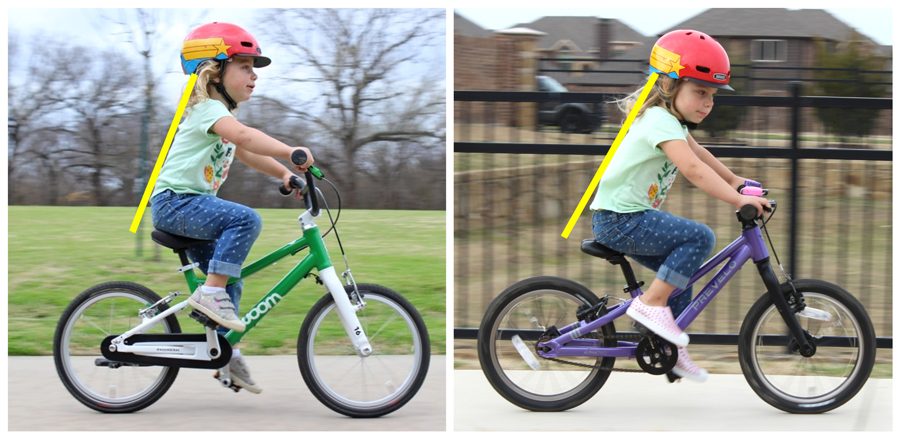
To make pedaling feel just as natural, woom was one of the first kids’ bike brands to design lightweight bikes with upright geometry that mimics this walking posture. The GO 3’s frame and components are carefully designed to keep a child’s shoulders stacked over their hips—allowing them to balance and pedal in a position their body already understands. Rather than asking kids to adapt to a bike, woom designed a bike that adapts to how kids instinctively move.
The result? A confidence-boosting bike that feels stable and intuitive from the first ride. By reducing the learning curve, the GO 3 helps kids stay upright and progress without all the stress. That said, upright geometry isn’t ideal for every rider.
More aggressive or adventurous riders—those eager to tackle hills, pump tracks, or navigate curbs and ramps—typically benefit from a more forward-leaning riding position. Bikes like the Prevelo Alpha Two and Early Rider Belter feature lower handlebar setups that allow kids to shift their weight forward, giving them greater control and agility in more technical or playful environments.
You can clearly see this difference in riding posture. In the comparison photo below, our (very tall) 3-year-old tester sits in a noticeably upright position on the woom 3, while the same rider leans significantly further forward on the more aggressive Prevelo Alpha 2.
Similarly, with our shorter 6-year-old tester, the lower handlebars on the Early Rider Belter allow him to lean into the bike and better center his weight while climbing a ramp—something that’s much harder to do with the taller riser bars on the woom 3.

Narrow Q-Factor = More Natural Pedaling
The Q-factor of a bike refers to the distance between the pedals. A wide Q-factor forces kids to splay their legs outward while pedaling—similar to walking with exaggeratedly wide steps. It’s awkward, inefficient, and can make balancing harder, especially for new riders.
woom was one of the first kids’ bike brands to prioritize a narrow Q-factor, allowing children to pedal with their legs moving straight down, rather than angled outward. This more natural motion not only feels better, but also helps kids stay centered and maintain balance more easily.
In the photo below, you can see how narrow and compact the woom 3’s frame is—notice how close the pedals are to each other. While our young rider is clearly being silly on the bike, it also illustrates how the narrow spacing allows for efficient pedaling without forcing the legs outward.

Many other kid-specific brands have followed suit, but the woom 3’s slim, carefully designed pedal spacing remains one of its most rider-friendly features—and a key reason why it continues to stand out as one of the best bikes for young beginners.
Dual Hand Brakes – No Coaster Brake
Most 16″ kids’ bikes come standard with a coaster brake (a backpedal brake), but the woom 3 featrues dual hand brakes and no coaster brake—a seemingly small detail that makes a big difference for beginner riders.
Why does ditching the coaster brake matter?
When kids are first learning to pedal, it’s common for them to pedal backward—either by mistake or to help regain balance. On bikes with a coaster brake, that backward motion causes the bike to stop abruptly, often leading to a crash. By eliminating the coaster brake entirely, the woom 3 gives kids the freedom to experiment and learn proper pedaling technique without fear of unexpected stops.
Color-Coded Levers Teach Proper Braking Technique
woom’s dual handbrake setup is also intentionally designed to help kids safely learn how to use two independent brakes. One of the biggest risks with hand brakes is that kids may accidentally squeeze the front brake too hard, which—on some bikes—can cause them to tip forward (known as an endo). While this is rare on 16” bikes, teaching kids to brake with the rear brake first is a valuable habit that helps prevent accidents as they move up in size.
But there’s a challenge: many kids at this age are still figuring out their left from their right. To help, woom uses color as a cue. The right-hand brake lever, which controls the rear brake, is bright green, while the front brake lever on the left remains black. This makes it much easier for kids to remember: “Brake with the green lever!”—instead of trying to recall which hand is which in a high-pressure moment.

The brake levers themselves are sized for small hands and come with a tool-free reach adjustment knob. If the levers feel too far for your child’s fingers, just pull in the lever and turn the side knob to bring it closer to the grip. It’s a simple, intuitive adjustment—and another rare feature that makes the woom 3 one of the most thoughtfully designed bikes for young riders.

Higher Gain Ratio = Higher Top Speeds
The woom 3 has a gain ratio of 3.85, which means it’s geared for slightly higher top speeds compared to many other 16″ bikes. While it takes a touch more effort to get going from a full stop, the payoff is clear: once up to speed, your child won’t be spinning their legs wildly just to keep up. This makes a big difference for kids trying to ride alongside faster friends or older siblings.
Despite the higher gearing, the woom GO 3 still offers a smooth and manageable start for most young riders. It strikes a great balance—easy enough for beginners, yet efficient enough for longer, faster rides.

For comparison, the Guardian 16 has a gain ratio of 3.55, and the Priority Start 16 comes in slightly lower at 3.4—both easier to get rolling from a stop but with a lower top speed. The Prevelo Alpha Two, designed for more aggressive riders, is close to the woom 3 with a gain ratio of 3.8. The Early Rider Belter 16 tops the list with the highest gain ratio at 4.0, making it the fastest of the bunch.
For families who want the best of both worlds, the upgraded woom GO 3 AUTOMAGIC may be the perfect fit.
woom GO 3 AUTOMAGIC – Two Gears, No Shifting Required
For an extra $50 and a small weight increase (1.5 lbs), the woom GO 3 AUTOMAGIC upgrades the standard single-speed setup with a 2-speed internally geared hub. With a starting gain ratio of 3.2, it’s easier to get rolling from a stop. Then, once the rider hits around 7 mph, it automatically shifts to a higher 4.4 gear—no shifting required.

Why does this matter? Most 16″ bikes can only offer one gear—so it’s a compromise. The standard woom 3’s 3.85 gain ratio strikes a great middle ground for beginners: low enough for easy starts, high enough for decent cruising. But as kids gain strength and confidence, that single gear can start to feel limiting, especially on longer or faster rides.
The AUTOMAGIC solves that by giving kids the easy start of a lower gear, paired with the speed and efficiency of a higher one—without requiring any gear management.
To see how the AUTOMAGIC performs, we ran head-to-head races at our local skatepark with three of our regular testers. Each rider did a lap on both versions of the woom 3—and every one of them preferred the AUTOMAGIC. The reduced leg spinning and increased cruising speed were immediately noticeable.If your child is a confident or aggressive rider, the AUTOMAGIC can be a fantastic bridge until they’re ready for a geared 20” bike.
The Downside: Not Ideal for Hill Climbs
While the AUTOMAGIC works beautifully on flat ground, it has one drawback: it tends to stay in the higher gear once it shifts—even on hills.
In our testing, once the hub shifted up (usually within a few seconds of pedaling), it rarely dropped back down, even when climbing. Though it’s supposed to downshift below 7 mph, we found that on inclines, it often remained in the higher 4.4 gear—making hills harder to manage for some kids. We did discover a workaround: a quick backpedal usually forces it to shift back to the easier gear. But if your child then pedals quickly to climb, it may shift up again mid-hill.
Who Should Choose AUTOMAGIC?
- Choose the AUTOMAGIC if your child is a fast, confident rider who loves speed and mostly rides on flat terrain. It’s a great way to extend the life of a 16” bike without overwhelming them with manual gears.
- Stick with the standard GO 3 if your child is timid, frequently rides hills, or you value the simplicity and consistency of a single, well-balanced gear.
woom GO 3 – Noteworthy Components
All-Terrain Tires
The woom GO 3 comes equipped with 1.4” wide Schwalbe Little Joe all-terrain tires, which strike a great balance between pavement efficiency and basic off-road capability. They offer low rolling resistance for smooth neighborhood rides but still have enough tread to handle compact dirt trails and gravel paths with confidence.

Compared to the smoother, street-style tires found on bikes like the Guardian 16 and Retrospec Koda Plus, the knobbier tread on the woom GO 3 provides noticeably better grip and versatility—making it a more capable choice for kids who like to venture off the beaten path.

Child-Specific Saddle
The woom GO 3 features an updated child-specific saddle that’s smaller, narrower, and more proportioned to fit young riders’ frames. It also has enhanced padding to provide greater comfort—especially on longer rides. In the image below, you can clearly see how much narrower and more compact the woom 3 saddle is compared to the saddle on the Retrospec Koda Plus 16.

While some of our testers previously found the older woom saddle a bit uncomfortable, this new version has earned zero complaints so far—always a good sign when it comes to picky young riders. The seat post has also been updated to include size markings.
Size Markings on Stem and Seat Post
The woom GO 3 is built to grow with your child—and adjusting it correctly is made simple thanks to A, B, and C size markings on both the seat post and the stem. These visual guides help parents match the handlebar position to the seat height. For example, if your child’s ideal saddle height falls in the “A” range, the handlebars should be rotated to align with the “A” marking as well. It’s a quick, visual way to ensure the bike is properly fitted for comfort and control.

To prevent scratching during adjustments, the seat tube includes a plastic insert that protects the frame from scuffs as the seat post slides up and down—another thoughtful touch that sets woom apart.
Ergonomic Grips
To round out the main touchpoints, the GO 3 is equipped with new ergonomic grips specifically designed for small hands. At just 19mm in diameter, they’re noticeably narrower than most kids’ bike grips, making them easier for little hands to grasp and control.

The palm platform provides a wider surface for the hand to rest on, helping to reduce fatigue on longer rides. And at the end of each grip, a thick bumper extends beyond the pinky finger, offering added protection to the outer hand in case of a fall.
Removable Steering Limiter
The GO 3 includes a removable turning limiter that serves two important purposes:
- It prevents brake cables from being stretched or damaged if the handlebars are twisted all the way around the headtube—a common scenario after a crash when a child picks up the bike and unknowingly spins the bars 360 degrees.
- It gently corrects sharp oversteering, helping new riders avoid jack-knifing when they accidentally turn the handlebars too far.
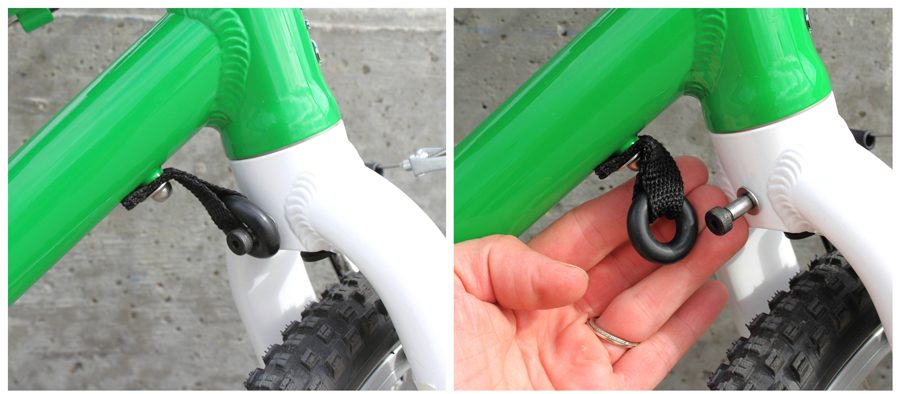
While the limiter can be removed as your child becomes more experienced, we generally don’t recommend it. In our testing, the cable protection it provides far outweighs any downside, and its subtle steering correction doesn’t interfere with kids learning proper turning technique. It’s a simple, smart feature that adds an extra layer of protection for both the rider and the bike.
Kickstand That Actually Works for Kids
Unlike most kids’ bike kickstands—which are mounted just behind the crank arm and can jam the pedals if left down—the GO 3’s rear-mounted kickstand is out of the way. If your child forgets to put it up, the pedals will still turn freely.

And when the kickstand touches the ground while riding, it naturally bounces up and out of the way. It’s another thoughtful design details that makes everyday riding easier (and less frustrating).
One-Winged Chainguard
One of the design updates on the woom GO 3 is its new chainguard. Unlike the fully enclosed guard on the older woom 3, the GO 3 features a “one-winged” design—fully covering the top portion of the chain and chainring, while leaving the lower section exposed.

This update makes it easier to perform basic maintenance, like lubing the chain or clearing debris, without having to remove the entire guard. It also reduces the chance of rubbing or rattle, a minor issue we occasionally encountered with the older, fully enclosed design.
POP Basket Compatibility
Last but not least, the GO 3 is compatible with woom’s POP basket, which fits securely on the handlebars without interfering with brake cables. There’s no bouncing, rattling, or slipping—just a stable, kid-friendly way to carry favorite stuffed animals, snacks, or playground finds.

And when the ride is over? With a quick tug of the handle, the basket easily pops off, so kids can bring their treasures—be it a beloved stuffy, shiny rock, or pinecone collection—along as the adventure continues off the bike.
woom GO 3 vs. Other Brands
As much as we love the woom GO 3, we know it’s not the right fit for every rider—or every budget. Whether your child is especially aggressive, smaller than average, or you’re looking for something more affordable, there are excellent alternatives out there.
After testing over 50 different 16” bikes, here are our top recommendations based on different needs:
For Beginning or Timid Riders
- If the woom GO 3 is too big:
Try the Biky 16 Air. It’s just as lightweight as the woom but has a minimum seat height that’s 0.5” lower, making it slightly better fit for petite riders. Keep in mind, it only has one hand brake and no kickstand. - If the woom is out of your budget:
The Priority Start 16 is our favorite mid-priced option, offering an aluminum frame and a grease-free belt drive. Close behind is the Guardian 16, which is also well-built but uses a heavier steel frame and a traditional chain drivetrain.
For Aggressive Riders
- For trick-loving kids or pump track regulars:
Go with the Early Rider Belter 16. It has the most aggressive geometry of any bike we’ve tested and the highest gain ratio (4.0) for serious speed and performance. - For shorter but confident riders:
The Prevelo Alpha Two is a great choice. It’s lightweight with a more leaned-in riding position and has a minimum seat height nearly 2” lower than the woom—ideal for smaller kids ready to shred.
woom 3 Bike Bottom Line
The woom GO 3 is a standout starter bike that’s built to inspire confidence from the very first pedal stroke. With its ultralight frame, upright geometry, thoughtfully designed touchpoints, and color-coded hand brakes, it’s one of the easiest bikes for young riders to learn and love.
Most impressive, though, is how this bike consistently transforms hesitant beginners into confident, happy riders—ready to cruise the neighborhood with ease. The smiles say it all.
If your child is a speed-loving rider who mostly sticks to flat terrain, the AUTOMAGIC 2-speed version is a smart upgrade. It offers smooth starts and faster cruising—no shifting required.
woom 3 Bike Video Review – Older Models
The footage features the older ORIGINAL version of the woom 3, but the size and geometry are nearly identical to the updated woom GO 3. This video also demonstrates the size difference between the woom 2 and the woom 3.
RECALL NOTICE: If you’re considering purchasing a used woom 3 ORIGINAL, be aware that the stems on models sold between September 2018 and March 2022 have been recalled by the CPSC. Before buying, check the woom’s Recall Notice to confirm the bike has been updated with the new stem.
FTC Disclosure: Affiliate links are included in this review. No monetary compensation was provided for this review, however, the reviewed product was supplied by the manufacturer or distributor to help facilitate this review. All opinions and images are that of Two Wheeling Tots LLC. All content and images are copyrighted and should not be used or replicated in any way. View our Terms of Use.
